Volume 4

Volume 2. No.4
July-August 2001
ARTICLES
The Alchemy in Spiritual Progress Part 4
Alchemy: the Cosmological Yoga Part 4
FEATURES
EDITORIAL
 The Alchemy in Spiritual Progress
Part 4: Conjunction
by Nanci Shanderá, Ph.D.
In the last three articles of this series, we’ve explored the first triad of alchemical transformation consisting of Calcination, Dissolution, and Separation. These three stages are the lower, earthbound processes of spiritual evolvement. In order to be fully spiritual and whole, we as humans must be grounded on the earth plane, accepting our human experience as a necessary and exquisite part of awakening. This idea is not accepted in many of the world’s religions, where it is taught that spiritual perfection is attained by denying and rejecting things of the earth, whether they be the human body or the earth itself. These beliefs imply that things of the physical plane have no value – some religions teach that our bodies are to be reviled and the earth a place of devilish seduction.
Alchemy’s “motto” is “As Above, So Below,” meaning that things of the earth are intrinsically interwoven with the heavens. Alchemists and shamans seek the balance between the two and from that balance, they effect transformations and healings. The symbol of the World Tree, found in many mystical traditions such as the Kabbalah, demonstrates that to be whole, we must have our branches in the heavens, but our roots in the earth, with the trunk as a highway flowing between the two states.
The fourth stage of alchemical transformation is Conjunction. It can be related to the chakral system where the heart is the fourth center of awareness. The heart can also represent the World Tree — they are both a central “clearing house” where the spiritual meets the physical and blends and harmonizes them so that higher states of consciousness may be integrated.
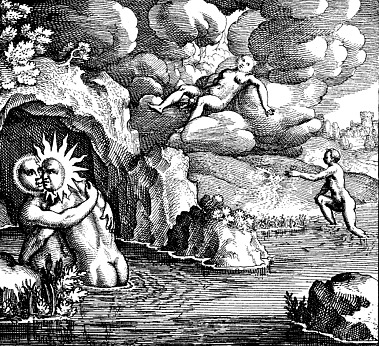
In Conjunction, we bring together the work done in Calcination, where the ego was burned to ashes, in Dissolution, where the emotions became more fully integrated and accepted without the ego’s interference, and in Separation, where we discovered what was of value in our lives and let go of anything that wasn’t. All of this is essential groundwork for the experience of Conjunction, where we are called to a higher way of relating to ourselves, to others, and to the world. It is a coming together, or Heiros gamos, the Sacred Marriage, of all that we are, have been, and will ever be. It brings us face-to-face with our Soul’s essence. Purpose takes on a new meaning. As a result of having been humbled in the first three stages (I like the image of being on one’s knees before the majesty and power of the Soul.), we are made ready to accept this marriage on deep inner levels of being.
This might manifest as a new attitude toward ourselves and others. If Separation set the stage for us to quit a meaningless job, for instance, we may be inspired to begin doing what we always wanted to do. In the conjunctive state of consciousness, there are fewer fears. The old “shoulds and shouldn’ts” are absent, or at least less powerful. Life takes on a new joyousness, laughter is more present. There is a sense of delight and excitement about the most mundane of activities because we experience acting in partnership with our Soul.
In Conjunction, we begin to have a delicious taste of who we truly are. We get a glimpse of our authentic Majesty and our eternal connectivity to all that is. Because this state is centered in the heart of compassion, we view ourselves with far more acceptance and love. This allows us to lovingly understand that the “mistakes” and ways of being in the past were “grist for the mill” – necessary practice for the greater consciousness yet to come. For example, if we have always battled with low self-regard, we can begin to perceive it as a self-regulating mechanism within that prevents us from integrating and manifesting our Majesty until the time is right. My spiritual mentor, Brugh Joy, M.D., teaches that the greater the pain / depression / low self-esteem / limitation / etc., the greater the gift. When I share that with my
students for the first time, I delight in the blank or confused looks on their faces because this statement holds the power to throw them into a perception of their world they have never considered before. To regard ourselves as not terrible after all but actually in the process of incubating a great and unique talent or gift to share with the world is mind-blowing for most people.
Conjunction poses questions for us that require choices about where we go from that point. The state of Conjunction is a pleasant enough place to be, but it also urges us to press on in our journeys so that we may at some future time come full circle and once again, touch into the heart’s full rapture, each next time expanding the experience in greater magnitude. While looking at Conjunction in your life, review your capacity for compassion toward others and yourself. The Sacred Marriage means being “in a state of love with” yourself and all your aspects, and with Life Itself. It may be time for you to practice the art of laughing at yourself non-judgmentally — you may be surprised at how delightful it is!
Next time, we will surrender to the heart’s urgings and move on to the fifth stage of alchemical transformation called Fermentation / Putrefaction, where we taste again the sacred fires in Calcination, but this time to a more finely-tuned degree. It is where we review what we have experienced while we are pulled into the more intense fire that creates the fermenting process that refines us further by urging us to die to old ways.
Nanci Shanderá, Ph.D. is a Mystery School teacher and spiritual counselor and dreamworker at EarthSpirit Center in Eagle Rock, California. This article is excerpted from her book in progress: Digging for Gold: the Art & Soul of Spiritual Experience. She can be reached at 323-254-5458. Her website is www.EarthSpiritCenter.com.
 Alchemy: the Cosmological Yoga
Part 4: Tantric Alchemy
by Maurice Aniane
It is clear that human love can be expanded to higher levels by alchemical ideas about cosmic sexuality. It is also clear that desire – experienced in detachment and innocence – could help the “red man” and the “white woman” of alchemy to capture at its very source the “femininity” of matter. This union in the service of the Great Work, however, was not easy. It implied at least three requirements. The first seems to have been an uncompromising purity and an extreme spiritual sensitivity, so that pleasure “might never close up on itself,” but might awaken an ever-expanding love and become less and less individual. Such love leads from the beauty of the body to that of the soul and finally is reabsorbed in “the love of God who created beauty.” Thus the unity of all the states of love” could lead from the embrace that blindly transmits death to the deathless, which, following the deep play on words of “the courts of love,” awakens the sense of eternity.
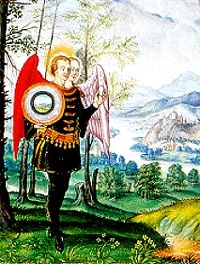
The second requirement was therefore to transpose this love into cosmic love. In the end, it was no longer this man or that woman but the Sun and the Moon which were united “to give birth to God.” “In this second operation,” wrote Flamel to a painter who had illustrated one of his works, “you have to put together two natures, the masculine and the feminine, and you have married them; that is, they form but one single body, which is the Androgyne or Hermaphrodite of the ancients. Thus the hermaphroditic state is the aim, that is, the secret origin which impels man and woman toward one another. In order to prepare this “passage to the end” the alchemical marriage was not presented as a vague fusion, but as a meeting face to face slowly transformed by the “Art” into a union of complementaries.
The third requirement of this love, the union of complementaries, relates the steps of the alchemical work to the relation of man and woman: the “dissolving” of the negative masculine in the positive feminine, the “fixation” of the negative feminine by the positive masculine. However, it is less a question here of successive phases than of a constant interaction that brings about more and more noble “crystallizations” (distillations) of love, until the final transmutation is achieved. This interaction is the key to the “operation with two vessels,” between which a vivifying and perfect circulation has to take place: these “twins” were so arranged that the product distilled from each, its “angel,” might pour in order to purify it into the opaque part of the other (yin/yang). A creative exchange which also seems to have constituted one of the foundations of Provençal love: “Everything takes place,” writes R. Nelli, “as if Provençal Erotica had tried to graft onto man the dominant ‘quality’ of woman: compassion for the body, ‘mercy’; and onto woman courage and masculine virtue.” (This graft, which seeks to actualize the androgyne in each partner, is wonderfully symbolized by two miniatures in a fifteenth century manuscript which Jung has reproduced in his work, Psychology and Alchemy: during the “mortification” which is a preparation for the marriage and which strikes both sexes simultaneously, the Tree of Life is seen to grow out of the belly of the man and out of the head of the woman; as if man, in order to become worthy of an authentic union, had to awaken the feminine part in himself, has to renounce the reasoning of the head in order to feel the motion of his entrails; and as a woman had to awaken her masculine part by freeing herself from the sensual and maternal despotism of her belly to take part lucidly in the vocation of man.)
Finally, it may be that alchemists knew, not only of the marriage properly so-called, but of certain erotic “techniques” similar to those of Tantrism and intended to awaken the energy of sex without allowing to be wasted in seminal emission The texts often present the Greco-Roman symbol of the naked Diana, which they liken to the Soul of the World, the vision of which is the goal of “the work in the whitening.” Now we know that the Medieval “pure love,” that is love without carnal union, included the contemplation of the Lady in the nude. As in Tantrism, where the “denudation of the virgin” symbolizes “purification,” the garments here represented the outer appearances. This practice implied a complete sublimation: the texts predicted that the profane who dare to gaze lustfully at the “naked Diana” would share the fate of Acteon — transformation into an animal (the Stag) which would be devoured by the dogs. So alchemy may have employed a Tantric maithuna, that is a ritual sexual union in which the sperm, in the moment of emission, is abruptly stopped and must “reascend,” so that the highest concentration of life which it embodies might immediately enter into movement on the psychic plane and provoke a liberating shock to the whole psycho-spiritual being. In fact, in a Hermetico-Kabbalist text, the Asch-Mézareph, we find a hint of a procedure of this kind in the reference to the biblical symbolism of the thrust of Phinea’s spear: “The lance pierces at the same time the solar Israelite and the lunar Midianite at their moment of their union and in locis genitalibus (in the genital region).” The point of force of the iron, acting on Matter, cleanses it of all its defilement. Here the Israelite is nothing other than masculine Sulfur and the Medianite should be understood as the Mercurial Water. Phineas’s lance not only kills the masculine Sulfur, but also mortifies his wife; and together they are transmuted by mingling their blood in a single act of generation: it is then in fact that the miracles of Phineas begin.”
Just as alchemy has allowed the sacred character of the flesh of the world to be maintained beneath the lofty asceticism of Christianity, so Tantrism seems to have been born from a lucid systematization of the concepts which underlie the deeply poetic and chastely carnal rites and myths of Hindu daily life, but which Vedantic speculation neglected more and more in favor of an apparently discursive and discarnate expression of the mystery of unity. These common roots, this partly analogous role, explain why the attitudes of Tantrism and alchemy converge. Both take the material body as their point of departure in order to transfigure it, since it is nothing other than the spiritual body identified with its own objectification by the process of cosmogonic “desire”. Thus the “diamond body” of Tantrism corresponds to the corpus glorificationis (glorified body) of Latin alchemy, and the symbol of the diamond is identical to that of the “stone,” which is also a diamond. It is because the two traditions have a similar conception of Nature: alchemy is clearly a “Shaktism” that assumes, even in its final obscuration, the immanent power of the Divine Principle to save man – according to the Tantric view – through the same means that habitually cause his downfall. Finally in both cases its is the same assumption of positive sexuality, which stops on the cosmic plane in alchemy and begins in divinis for Tantrism: the opposition of Sulfur and Mercury thus appears as a relatively contingent application of the metaphysical polarization between Shiva and his Shakti.
Under these conditions, it is normal to observe the very great resemblances between the subtle “physiology” of Tantrism and that of alchemy. The multiplicity of nadis, those currents of subtle force which furrow and “animate” the organism, culminate in a duality, that of two opposed arteries called pingalâ and idâ . Idâ, whose symbolic color is a very pale white, represents a “lunar” current linked to the Shakti principle; pingalâ, a brilliant red in color, is a “solar” Shivaic current. These two nadis, which emerge from the sacral region and intertwine around the vertebral column, correspond in alchemical language to the two serpents of the caduceus, opposed to each other as are the white, lunar Mercury and the red, solar Sulfur. Just as the duality of idâ and pingalâ is resolved at the moment of spiritual realization in the unity of the central artery, the sushûmna, so the two serpents that were fighting each other, now having been struck by the staff of Hermes, entwine themselves around it, and henceforth tame, bring to the god of twofold theurgical power to “bind” and “unbind.” Cosmic nature in its latent state, needing to be awakened and mastered, is symbolized, in alchemy as in Tantrism, by a serpent coiled around itself: the Ouroboros and Kundalini. Both traditions relate this Saturnic or leaden serpent with heaviness, sleep, and earth. The Hermetic visita interiora terrae (visit the interior of the earth) corresponds the descent to the mulâdhâra chakra, the subtle center that is at the root of bodily existence. Tantrism locates this chakra at the base of the spinal column, and one might suppose that an analogous localization was known to alchemy, since it, like Tantras, relates the earth force to the sexual function, and often situates the lunar center, which corresponds to the totality of the vital energies, at the base of the spinal column in the Holy Grail of the body, the sacrum.
The qualities of the idâ and pingalâ (Mercury and Sulfur) ascend through this stem (sushûmna). There they generate the colors and energies of the individual charkas. A bud of flowers on the stem later, which is a New Body, resembling the one which originally had its roots in the Earth, and from then on assuming a more subtle form.” A true correspondence between the subtle centers of alchemy and those of Tantrism are clearly established in the four centers rising by steps from the sacral region to the heart. Or rather, it is only in the case of the heart that the correspondence is complete. The three lower alchemical centers represent only the Shaktic mercurial modality of the corresponding chakras, while their Shivaic sulfurous modality is found in the alchemical centers situated above the heart. For example, the mulâdhâra chakra is identified, not with a single lunar center, but with the union between the lunar center and the Saturnian center. This chakra is in fact not only related to the vital force of the Kundalini, but also to the “god of the earth” symbolized by the massiveness of the elephant, which corresponds most clearly to Saturn and the heaviness of lead.
The centers that alchemy places above the heart seem to have little to do with the traditional Tantric chakras whose localization is approximately the same (but which represent siddhas or psychic abilities). In purest Tantric terms, the alchemical realization stops at the heart. This difference is easy to understand: Tantrism is an integral (or grounded) spiritual way, the last “adaptation” of the Hindu tradition: the conquest of the heart, that is, of the center of the human being in which the supreme center is reflected, is thus in that context no more than a stage leading to the “ascent” toward higher states of being. The heart marks the moment where the man who has discovered his center is made cosmic; above, the highest charkas symbolize the supraformal “heavens,” and the passage to the ultimate union with transcendent powers. Alchemy, on the contrary, is a cosmological science (coming from Above), which never claimed to be self-sufficient. It has always been subordinate to a spiritual way of union, whether one is considering the sacerdotal part of the Egyptian tradition, of Sufism, of Byzantine Hesychasm, or of the great Western “intellectualized” mystical tradition. That is why it focuses on establishing a contact in the heart with the “solar” ray of transcendence from Above and sees the dissolving of the world in its center (putrefaction) as subsequent to an equally important restoration. Although, in all fairness, it should be noted that in the most evolved forms of spiritual alchemy, there is a return to the earth at the heart level that is identical to the Tantric place of completion; it is the alchemical final conjunction, a cosmic union of the Above and the Below within created matter.
Feminine Alchemy
by Lindi Atkinson
Alchemy has always held a fascination for me, however I felt it to be somewhat dry and couldn’t quite see it as a “Spiritual Path.” It wasn’t until I began to research the Gods and Goddesses (the Netters) of ancient Egypt, that alchemy came alive for me. This time, however, I started to see that there existed some kind of female alchemical path in ancient Egypt. Veiled deeply in the Egyptian myths is the idea of mystical, magical sex connected to the transformation of Self and the immortality of the soul. Alchemy was alive in ancient Egypt (ie, the old Kingdom) and was carried along on a wave of symbolism through future ages. The Troubadours understood the magic of the feminine, when they sang songs to their lovers, and in so doing allowed the “Spirit of Sophia” (wisdom) to come out from behind the eyes of the woman.
The women of the Golden Dawn, those women behind the man himself, Aleister Crowley, also understood female alchemy. These three women held the understanding that at the point of orgasm, when both partners are simultaneously turned inward (giving and receiving), at this moment both become that; that which is Above and that which is Below. In other words during conscious lovemaking what happens in our bodies, also happens in the heavens (or space) and visa versa “as Above, so Below”. This understanding is symbolized by “Nuit” the Egyptian (Black) Goddess who represents the infinite space and infinite stars. At least three Egyptian Goddesses have a link with alchemy and the transmutation of Self. Sehkmet, the lioness Goddess, is not only solar heat, but she is the divinity of sexual pleasure.
Isis, Queen of magic, Goddess of Ten Thousand names. Goddess of love, truth, and beauty. Nuit, the Goddess of the night sky, whose name literally means heaven, is the Goddess often invoked in sex magic, where the return to primal unity requires union of male and female.
As in meditation, when the outward five senses are turned inward, when we participate in conscious lovemaking, the five senses are also turned inward. Both partners see nothing, outwardly, there is a blindness during orgasm. It is here, in this place of blindness that a flow of nectar is stimulated through the whole system. The power of conscious orgasm, and the magic stuff that comes with it, can, and does,
transform, not just both partners but the heavens Above, and the earth Below!
One of the starting points for alchemy is magical sex. The transference of certain products of the body during magical sex can bring about transformation. I’m going to digress here, and say something about Isis, so that I may hopefully, tie all this together. Isis holds a secret. Her “method” was a secret, that included a love feast, (which the Gnostics knew about and practiced). The love feast was entered into by
those who believed that union with each other and with other worlds was gained by the imbibing of each others sexual fluids. The theology was that the Goddess/God substances scattered throughout the universe were only truly brought together in humans, and that the collected essences could be shared, hence recreating the undivided God or Goddess. This was the secret of the veiled Isis. Isis holds many keys, one being the key to the immortality of the soul through her Star Fire. I have coined “Feminine Alchemy” here, in an attempt to explain how our sexual encounters can be transformed when this kind of exchange is made. Time and again Isis has entered my meditations as the One who assists us in the raising of powerful psychological energy and the transmutation of it into energy for spiritual growth.
Lindi Atkinson lives in beautiful Byron Bay, Australia. She has been researching Isis and spiritual alchemy in an attempt to understand the connection between Egypt, alchemy and Isis. Her email is [email protected] .
 EATURES
New Releases
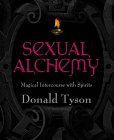
Sexual Alchemy: Magical Intercourse with Spirits
by Donald Tyson
Click on bookcover to order online. 348 pages (September 2000). Llewellyn Publications; ISBN: 1567187412. 9.0 x 7.5 inches.
Donald Tyson has written a number of books on Hermeticism, including New Millennium Magic, Three Books of Occult Philosophy, Ritual Magic, and Tetragrammaton. His latest book, Sexual Alchemy, is his most daring and intriguing work. He introduces the reader to a system of Hermetic rituals and magic that allows one to discover a sexual spiritual union far surpassing the pleasures of physical sex. One chapter is even devoted to using the True Imagination to choose a lover by working with telesmatic images — building up the body shape, facial features, and overt personality traits for a spirit based solely on its name, or its function in the world.
If sex with spirits is not what you are looking for, however, this book is still a treasure trove of alchemical secrets. He instructs us in various techniques for creating a homunculus (an artificial human); rituals to encourage the movement of the Secret Fire (kundalini energy); and some explicit Tantric practices, including the use of the Oil, the White Powder, and the Red Powder.
Laboratory Notes
Procuring Native Vitriol
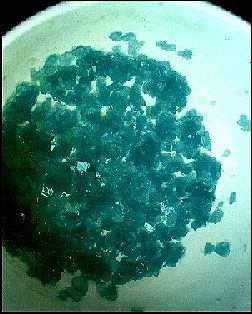 We know that some brothers have difficulty in getting natural Vitriol for the alchemic and spagyrical works. This pure natural Vitriol crystal is shown in the picture to the left. In my country (Portugal) we have pyrite and calcopirite mines 200 km from our residence. Those mines are located at Alentejo in Aljustrel, but at present, they are closed and it is not possible to find anymore native vitriol of such pure Mars quality as found inside the mines on stalactites formations that weigh more than 2 kilograms each. However, outside of the mines, the pyrite that was removed from inside the mine gathers and it is abandoned to the intemperate weather. The rainwater drags the natural pyrite sulfatization and forms small lakes with thousands of liters of saturated water of Mars’s salts. The mines being far away, we reached the conclusion that we were able by the same process, to produce a natural vitriol exposing the pyrites to the intemperate weather and collecting later the salt saturated liquid. For that, we acquired at a junk-dealer an iron-enameled bathtub and place it in the out doors with about a hundred kilograms of pyrite. Because of the sulfatization of the pyrite by the intemperate weather, the rainwater dissolves that sulfate and remains in the bathtub a Vitriol saturated water that will be drained later. If it rains too much, cover the bathtub with a plastic to avoid the water excess. As soon as the weather improves the bathtub will be uncovered and the content is again exposed to the weather. In the summer, as it doesn’t rain as much, pour on to the pyrite, rainwater collected in the spring and kept in 50 liter plastic barrel. When you see that the water is saturates of salt, open de bathtub drain to drain the water and after, crystallize the salt.
If you intend to have Hungarian Vitriol instead of pyrite, use Calcopirite, which is, a Mars and Venus sulfide but this is a little more difficult to find. However, you can join commercial Venus vitriol to the pyrite to obtain Roman Vitriol. It is not very advisable under the alchemic point of view but if there is no other solution, you have at least, a natural salt to dissolve the commercial. By this process, you can easily obtain a natural Vitriol that you need without having to travel to the mines because you will haven’t the ore on the outside of all mines with the conditions in which the small artificial lakes have been forming.
Don’t worry about the pollution because the mother water originating from the sulfate dissolution before used should be filtered by cotton where all the dregs insoluble in water will be retained. If you reside in the city and you need to collect rainwater, do it in the spring preferably during thunderstorm days, and placing on the window outside a big plastic basin well secured on the inside of the room. It isn’t advisable to collect the rainwater in the first days of rain because it is impregnated with dusts and residues that are in suspension in the atmosphere and deposited on the roofs. Keep it in large 5 liter glass bottles, which will preserve some years if it is not polluted with organic material.
Rubellus Petrinus is a Portuguese alchemist who offers an excellent multi-language website devoted to the operative and speculative aspects of alchemy at http://planeta.clix.pt/petrinus/alchemy-e.htm.)
Alchemy Lectures and Workshops
John Dee Colloquium. Denmark. December 6-7.
A public colloquium on the life and work of John Dee will be held at the University of Aarhus in Denmark December 6 and 7, 2001. This is the third in a series that has been previously held at Birkbeck College in London and the University of Szeged in Hungary. Papers are invited. Contact: Jan Backlund, Center for Cultural Research, Univ. of Aarhus, Finlandsgade 8200, Aarhus N, Denmark. Email: [email protected]. Fax: 45-86-10-82-28.
Art and Alchemy Conference. Denmark. December 7-9.
An international conference on the history of alchemy and the intertwined history of art will be held at the University of Aarhus in Denmark from December 7 to 9, 2001. The focus is on alchemical interpretation of art and the use of alchemy in modern art. Proposals for presentations should be sent by August 1. Contact: Jan Backlund, Center for Cultural Research, Univ. of Aarhus, Finlandsgade 8200, Aarhus N, Denmark. Email: [email protected]. Fax: 45-86-10-82-28.
Indian Alchemy and Ayurveda Seminar. January 2002.
An alchemy seminar, with master Alchemist Prof. Junius, is to be held in beautiful Byron Bay, Australia, in January 2002. The workshop will be over three days. Bookings essential A.S.A.P! Cost: $200. Please contact [email protected] for further info.
EDITORIAL
From the Editor (Dennis William Hauck)
As you may have guessed, the theme of this issue is sexual alchemy. Despite the acceptance of Eastern sexual alchemy, Western sexual alchemy has always been a little more suspect. Talking openly about this subject in the Middle Ages landed not a few alchemists on the bonfire. Even today, we tend to think of European alchemists as lecherous old men when it came to their sexual cultivations. Once again, clarity comes to the situation when we follow the Hermetic dictum of working on all three levels of reality. The bed becomes an alchemist’s laboratory when the “work” is done simultaneously on the bodily, mental, and spiritual levels. In fact, that is about as good a definition of “true love” as I can think of.
Future themes for this journal will include alchemy of the kabballah, the Tarot, Paracelsus, spagyrics, Dee and Kelley, Egyptian alchemy, and Islamic alchemy. Please feel free to submit your articles or artwork on these topics. We are always looking for good material!
Submissions
Submit your articles on any aspect of alchemy. We are looking for biographies, historical articles, practical laboratory work, spagyric recipes, philosophical pieces, experiences in personal transformation, spiritual insights, Hermeticism, Gnosticism, book reviews, film and video reviews, website reviews, artwork, etc. Please submit your material or queries to the Alchemy Journal, P.O. Box 22201, Sacramento, CA 95822-0201. You may also submit materials via email to the Editor or to the Assistant Editor, Tiffany-Nicole Hill at [email protected].
Acknowledgements
“Alchemy: The Cosmological Yoga” by Maurice Aniane is from an article of the same name that first appeared in Material for Thought magazine, San Francisco, Califorrnia in Spring 1976.
Subscriptions
The Alchemy Journal is posted bimonthly at the Alchemy Lab website on the journal archives page at www.AlchemyLab.com/journal.htm. To subscribe to the journal, send a blank email to [email protected].
© 2003 All Rights Reserved. Published by the Emerald Tablet Exchange (ETX), P.O. Box 22201, Sacramento, CA 95822-0201 USA