Alchemy Journal Vol.2 No.2
March/April 2001
CONTENTS
ARTICLES
Hermetic Meaning of the Sign of the Cross
The Alchemy in Spiritual Progress Part 2
Alchemy: the Cosmological Yoga Part 3
FEATURES
EDITORIAL
 Hermetic Meaning of the Sign of the Cross
(by Mark Stavish, M.A.)
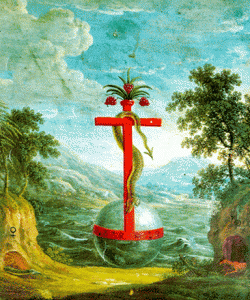
Gestures and symbols have always played a major part in the Western Mystery traditions. Yet, of all symbols, the cross has been the most prominent and influential in guiding western mystics towards cosmic consciousness. While seen as almost an exclusively Christian symbol, the cross has existed since the dawn of the mysteries. The Egyptian tau and anhk, the Cross of Christ’s Passion, the Rosy Cross of the medieval and Rennaissance alchemists, to the post-Vatican Two cross of the Resurrected Savior, all are historical variations of the same symbol that has lead a large part of humanity on its path to God.
Generally, the cross is seen as the linking of an upright line with a horizontal line, or the active (I) with the passive, or receptive (-). When these two forces are combined, we have the creation of a third force, idea, or entity. While definite early sexual symbolism is present, it is on the psychological and spiritual levels that the cross is most fully explored. The Egyptian ahnk, or looped cross, is said to be an example of this early sexual (i.e. creative) symbolism, however, most of its later uses are as a sign of life force and divine power in a complete sense.
Jung suggests that the cross has its origins in humanities discovery of fire, and as such, is in reality a fire symbol derived from primitive man’s rubbing of two sticks together in order to start a fire for warmth, protection, and the creation of tools. It is interesting to note, that words signifying cross, such as krois, krouz, kreuz, crux, cruz, or croaz, possess etymological similarities with words signifying fire. The roots ak, ur, or os, all signify cosmic light or fire.
The earliest crosses were simply marked as (T) or (X). Later variations added the additional arm to the top to form a (t or +). The equal armed cross (+) was used to represent the four cardinal directions, elements, colors of mankind (Hopi lore), as well as the Four Heavens of Zoroaster and its later variation in Jewish Qabbalah. When circled it became the four seasons, stages of life, and all of the associations of life, death, and re-birth.
Plato in Timaeus tells how the Demiurge reunited the broken parts of the fragmented ‘World Soul’ through two sutures shaped like, what we call, the Saint Andrew’s Cross (X). The Egyptian ahnk, or looped cross, has for many, been the symbol of humanities resurrection, in that it shows the initiate greeting the day with arms outstretched and head held high. One theosophical writer calls this posture the “Madonna Posture” as if we are attempting to embrace all of creation. She further states that it is also good for the thymus gland/heart area, in that it creates a feeling of openness and compassion, right where the vertical and horizontal shafts meet.
During the Middle Ages the cross became chiefly associated with the crucifixion of Christ. As a result, the cross in an upright manner (+) became the symbol of Divine Power and Presence, the defeat of death and ignorance. By logic, the inverted cross, then became the symbol of blasphemy, demonic power, or the rejection of Christ’s sacrifice. Yet this was a strictly historical interpretation a that time, for Saint Peter requested crucifixion in this manner, inverted, as he felt he was not good enough to hang the same way as did Jesus. Earlier, and later, mystical doctrines use the various forms of the cross to signify different flows of Cosmic force, potential, and rhythm.
In England the cross was associated with the Yew tree, often seen growing in churchyards. Christ in medieval songs and stories is said to have been ‘hung on a tree’ just like the Norse god Odin. Christian mystics would later change this to the “Tree of Life” of medieval Jewish mysticism, or Qabbalah.
By using the sign of the cross in a conscious manner, we can create within ourselves a condition that is supportive of mystical experiences and expanded awareness. We in fact, make ourselves, open and willing channels for Cosmic Wisdom, Universal Love, and Creative Power to manifest in our lives and the world. The Christian mystics called this the ‘axis mundi’ or World Axis – the joining of heaven and earth.
In his work, The Nature and Use of Ritual, Roche de Coppens quotes a masonic-rosicrucian document in which ‘Bishop Theodotus’ states: “When we say ‘In the Name of the Father’ and place our fingers on the forehead, we actually point to an important organ in our spiritual body just below the space where God dwells in us ‘on high’. The vibrations set up in motion by our loving thought about our heavenly Father activates the Divine Essence of the ‘Crown’ which pours into our Heart center as a veritable though unseen Glory (Shaft of White Light). This activation of the ‘Crown’ itself is described by St. Peter: ‘Ye shall receive a Crown of Glory’. When we say; ‘And of the Son’ and place our fingers on our heart, we again actually point to a space in our spiritual body where the Divine Light, in the words of the Prophet Isaiah poured upon us from ‘on high’, is activating another spiritual organ suffusing us with the Divine Love of the Son. And when we say: ‘And of the Holy Spirit’, touching our right and left breast respectively, we activate these spiritual sensoria within us which manifest as the creative and vitalizing power of the Holy Spirit in our lives. Finally, when we say: “Amen’ and join our hands together, mentally affirming the presence of the Triune God within us, we actually close the spiritual currents within the periphery of our spiritual body in order to maintain this awakening to spiritual awareness as long as possible.” (from the S.R.I.A. Documents)
By bearing the cross of incarnation, like the Cosmic Christ before us, we can know the light of our Inner spiritual cross of Illumination, Resurrection, and Salvation. Just as Constantine went ‘by way of the cross’ so can we know the esoteric meaning of ‘via crucis’ in our daily lives. By acknowledging, accepting, invoking, and applying Cosmic Wisdom, Universal Love, and connecting the two through the power of the Holy Creative Spirit, we can personally know the Christ Within. When this happens, we partake of the true spiritual communion, or Holy Mass, in which all are joined in the ‘Corpus Mystica Christi’ or Mystical Body of Christ.
It is here, that all true and sincere believers are united in the Invisible Church of which Eckarthuasen spoke: “It is necessary, my dear brothers in the Lord (Cosmic Consciousness), to give you a clear idea of the interior Church; that of the illuminated Community of God which is scattered throughout the world, but which governs by one truth and (is) united in one spirit…. It is the most hidden of communities yet possesses members from many circles; of such is this School. From all time there has been an exterior school based on an interior one, of which it is but the outer expression. From all time, therefore, there has been a hidden assembly, a society of the Elect … called the interior Sanctuary or Church….But when men multiplied, the frailty of man and h weakness necessitated an exterior society which veiled the interior one, and concealed the spirit and truth in the letter … wrapped in external and perceptible ceremonies … which the symbol of the interior, might by degrees be enabled safely to approach the interior spiritual truths … so that the sensuous man could … be gradually … led to interior truth …” (from Cloud Upon the Sanctuary, Letter Two, von Eckharthausen)
Since the ‘Occult Revival Period’ of the 19th and early 20th centuries, several variations of the Sign of the Cross as a mystical and magical gesture have become public. While many of the organizations that lay claim to these techniques also make claims of somewhat questionable historical antiquity, the effectiveness of the method is what must be judged, and not history that may be more mythology than fact.
One of the largest, most splintered, and yet surprisingly effective of these movements is Martinism. Tracing its lineage to the French “Unknown Philosopher” Louis Claude de St.-Martin, and his rogue teacher and master, Martinez Pasquales, Martinism came into full bloom in Europe, America, and other areas around the world, prior to World War One. Under the careful formation and leadership of Dr. Gerarde “Papus” Encausse, Martinism quickly grew into one of the largest and most widespread mystical movements in the world. Unfortunately, such quick and sudden growth also led to a fractioning of the original Martinist Order into several schismatic organizations and independent lodges. Despite their political quarrels, and doctrinal differences, they all remained true to their rituals, teaching methods, and core beliefs. Since Martinism identifies and defines itself as “esoteric, Christian knighthood” based on initiation and the Qabbalah, it is no surprise that several variations of the cross appear in some of its rituals.
In The Martinist Tradition (vol. 1), Rene Cossey gives a copy of a Martinist ritual. The preface to the ritual outlines some of the long-standing history of the cross in both Christian and pre-christian periods. Quoting Jean Danielou’s Les Symboles Chretiens Primitifs (Paris, 1961), Cossey points out that the tau was used as a “Sign of the Elect” in the Old Testament, being traced on the heads of the initiates by the Angel of Yahweh. The ancient Egyptians, Gnostics, Eleusian Mysteries, and Rites of Dionysos, all had uses for the tau prior to its being written about in Revelations, or adopted as the Passion Sign of Christ.
The High Priest of Israel had it traced upon his head with Oil of Unction upon his consecration. Early Christians in North Africa had it painted or tatooed on their heads as as sign of faith. Medieval rabbi’s visualized it as they were tossed into the flames during the Inquisition as a shortened version of the Tetragrammaton. For the purpose of this ritual however, the ‘operator’ is advised to trace it upon his or her forehead with their right thumb (while possibly visualizing it in the aforesaid Qabbalistic fashion), after making a plea for Divine Intercession in the world’s state of affairs. At one point however, the ritual changes to tracing the cross with the thumb, as well as the forefinger and middle finger. This possibly symbolizes the coming together of various Cosmic forces. An alternate method of tracing it is to use a candle in the air in front of oneself. By drawing it as such () it symbolizes resurrection, when drawn () it symbolizes Divine incarnation or assistance.
While the teachings of Martinism have had a wide influence on many mystical organizations, particularly those either claiming the Martinist banner, or of a Rosicrucian variety, the Hermetic order of the Golden Dawn has by far had the widest and most well publicized impact on Western occult thought in the last 100 years. Formed in the last quarter of the 19th century, the Golden Dawn was a direct off-shoot of a quasi-masonic Organization calling itself the Society Rosicrucia in Anglia (S.R.I.A.). Formed by a group of Masonic scholars seeking the Rosicrucian roots of the Masonic Order, the SRIA later became the nucleus for the Golden Dawn. Through the Golden Dawn, the S.I.R.A. sought to establish an outer organization where members could be trained in spiritual rites, whereby they might be prepared for later admittance into the Order of the Ruby Rose and Golden Cross, or their version of the Rosicrucian Order. Like Martinism which came only a few years later, the Golden Dawn sought to re-establish the lost entrance way into the secret and highly sought after Rosicrucian Order.
The Golden Dawn’s greatest contribution to the understanding of the Sign of the Cross comes in its highly revered ritual meditation known as the “Qabbalistic Cross”. In this ritual, like that described by Bishop Theodotus, the initiate visualizes brilliant spheres of light and the formation of a cross of white or golden light within themselves as they recite the invocation: “For thine (head), is the Kingdom (heart), and the Power (right shoulder), and the Glory (left shoulder), unto the ages, Amen (hands together in prayer).” This simply, but powerful act, when done with concentration and sincerity, can bring us into contact with Cosmic Wisdom, Love, and Creative Power, just as its Christian variation can.
While this is just a brief and hopefully practical introduction to the meaning and uses of the cross by mystics across the ages, it is important to remember, as Eckharhausen has pointed out to us, we are not alone on our spiritual journey. We are supported by a host of “Unknown Superiors” or invisible allies that constantly seek to uphold us on our Pilgims Progress. By seeking a deeper understanding of our spiritual symbols, and using them in our daily meditations and prayers, we can strengthen ourselves inwardly and bring ourselves one step closer to God’s promised Kingdom – “Via Crucis!”
Mark Stavish is a long-time student of esotericism and has written over a two-dozen critically received articles, book reviews, and interviews on western esoteric philosophy and practices. Email: [email protected]. Website: www.hermetic.com/stavish.
By using the sign of the cross in a conscious manner, we can create within ourselves a condition that is supportive of mystical experiences and expanded awareness. We in fact, make ourselves, open and willing channels for Cosmic Wisdom, Universal Love, and Creative Power to manifest in our lives and the world. The Christian mystics called this the ‘axis mundi’ or World Axis – the joining of heaven and earth.
 The Alchemy in Spiritual Progress
Part 2: Dissolution
In Part I of this seven-part series of articles, we considered the first stage of alchemical transformation, Calcination, where our egos are shocked, disillusioned, deflated, thrown into the abyss, torn to shreds, or burned to ashes. We discussed the purpose of this as preparation for personal awakening, the state of consciousness where we know who we are, why we are here, and how we are an integral and essential thread in the cosmic tapestry. (Check your ego on that statement: does it recoil at the idea of being “just a thread?”)
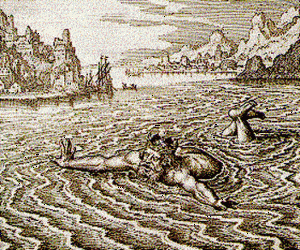
This time we will approach the second stage of alchemical transformation: Dissolution. This is the experience of being dissolved into the waters of emotion, often experienced as tears, crying, sobbing, feeling totally lost and fearful of the unknown. It comes about as a result of the ego’s deflation in the Calcination stage. As the ego’s rigid control over our lives is released temporarily (this is not fully completed without many such experiences which ultimately create a new pattern), we experience underlying structures created to protect our more fragile aspects of beingness which are based in fear. Fear of the unknown. Fear of feeling. Fear of emotion. Fear of revealing who we truly are. Fear of being who we truly are. The ego leads us to believe that if we reveal who we really are we will be somehow harmed,
rejected, denied, criticized, or annihilated.
The origin of this ego-based belief system lies in our childhood, when we were truly unable to protect ourselves in most areas of our lives. So we “hired” our egos to protect us by creating an “I don’t care” attitude, seeming cold and aloof. Or we might have used emotional displays to confuse and control others, and in so doing, we were protected from being vulnerable. Or we could have chosen to be a “nice girl or boy,” which is a way we live on the edge of our sensitivities, but without revealing the full range of our feelings in order to remain “safe.”
In Dissolution, we make active use of the waters of emotion in order to “re-own,” or take charge again of, our natural emotions – in other words, it takes expression of emotion to access and integrate the original and necessary emotional core within us. It’s the alchemical process of dissolving the ashes of Calcination in water (emotion) so we may further refine the raw material of our Soul. In this second stage, we are seeking to bring back to conscious presence the emotions we repressed because of fear of others’ reactions to them. Most of us learned very early that society tends to judge emotions harshly, unless they are “acceptable,” such as love. But authentic
Love encompasses all with the compassion of understanding and acceptance. It is not exclusive, qualifying the only ways we can experience it. In a state of true Love, we would know that emotions take two basic forms: Soul emotions and human emotions. Soul emotions are Love, grief, anger, sadness, and joy. Human emotions are feelings based in jealousy, rage, pettiness, fear, competition, manipulation, etc. But before you nod and say these human emotions are “the bad ones,” look again. If Love encompasses all, then it must include these difficult feelings. Perhaps the unconditionality of such a Love allows for the human state of beingness to experience “learning” emotions, those which are presented to us here on earth to help us to evolve and awaken. The purpose of such emotions is to challenge and strengthen us in our resolve to grow and to seek the highest possible outcome of every experience.
You may still be questioning why the emotions of the Soul would include grief, anger, and sadness. Most tend to think the more difficult emotions would not exist in higher realms of consciousness. But in research done on the between-lifetimes states of consciousness (I recommend books by Michael Newton, Ph.D. and Joel L. Whitton, Ph.D., on this subject) is has been found that a majority of subjects reported feelings as being a necessary part of the learning experiences between one life and the next. There is a “life review” in this period, where the Soul looks at the life just experienced. If we did anything to regret, we feel sorrow, remorse, or anger at having done so. These feelings help us make changes that help us to evolve. Our Soul may then choose to re-embody in the next lifetime in a way that corrects and rebalances the wrong that was done.
Whether on the Soul level or in the human realm, emotions are essential parts of our beingness. Rejected, they become heavy, dark aspects of ourselves that we live in fear of. We put great energy into trying to fool ourselves and others into believing that we don’t have those unacceptable feelings. The fascinating thing about running away from our fears is that when we finally are confronted by whatever it is that we’ve protected ourselves against, the thing itself is never as bad as our fears had us believe. Many people feel amazed, and even a little foolish, at how much time, effort, and energy they put into hiding a feeling, only to discover that when re-integrated, it made them feel whole. The fear of being annihilated by an emotion is the fear of feeling alive. Isn’t it funny what we do to avoid it and yet pursue it anyway?
Next time, we will work with the third stage of alchemical transformation called Separation, which is the experience of further sifting through the ashes to discover what is truly valuable in our lives. Until then, consider your emotions and how valuable they really are to you. Perhaps it’s time to unconditionally accept them.
Nanci Shanderá, Ph.D. is a Mystery School teacher and spiritual counselor and dreamworker at EarthSpirit Center in Eagle Rock, California. This article is excerpted from her book in progress: Digging for Gold: the Art & Soul of Spiritual Experience. She can be reached at (323) 254-5458. Website: www.EarthSpiritCenter.com.
In Dissolution, we make active use of the waters of emotion in order to
“re-own,” or take charge again of, our natural emotions – in other words, it takes expression of emotion to access and integrate the original and
necessary emotional core within us.
Alchemy: the Cosmological Yoga
Part 3: Methods of the Work
(by Maurice Aniane)
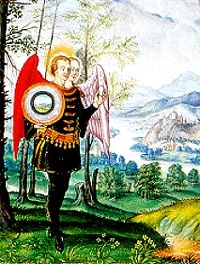
The ancient character of alchemical ascetism explains why it has less to do with renunciation than with detachment, less with escape from the world than with a purified participation in its divine celebration. It can be said that its aim is in fact the penetration of the cosmic ambiance, a “cosmicization” of the soul, to use the expression of Mircea Eliade. Like the vas Hermetis that is its support for meditation and in a way its symbol, the soul of the alchemist must become “round” so as to “imitate” the spherical perfection of the cosmos; it must contain the earth and its lower fire, heaven with its sun and moon. It must “be homologized” to the world, so as to become, with it, the “womb” and the “egg” from which the Filius philosophorum, the miraculous stone, will be born.
Since, according to the proverb, “one cannot make gold except with gold,” the alchemist will begin from the grains scattered in ordinary life, “moments of suspension” or “golden instants,” which will sometimes rend our sleep and allow a glimmer of the inner gold to filter through to us, through the mountain of our ignorance. To collect these grains of gold, the major practice of alchemy seems to have been “imagination”: not imagination in the ordinary sense, but “true imagination” which the texts carefully oppose to “fantasy.” True imagination actually “sees” the “subtle” processes of nature and their angelic prototypes. It is the capacity to reproduce in oneself the cosmogenic unfolding, the permanent creation of the world in the sense in which all creation, finally, is only a Divine Imagination. It is also the faculty of interpreting Biblical tales and Greco-Roman myths as ever-present realities which lead the universe back to God through the mediation of sacred time in which there then exists but one Man.
The true imagination of alchemy is a vision: it sees space as a symbol and time as a liturgy. “Horizontally,” it penetrates the subtle ambiance, it is “the star in man, the celestial body,” the astrum being in this case an expression derived from Paracelsus which signifies the Soul of the World. “Vertically,” this imagination leads cosmic life thus deciphered back to spiritual reality: it then takes the name of “meditation,” “inmensa diuturnitas meditationis,” and consists of the prolonged and silent invocation of God or rather of the “inner angel,” of the “good angel”: indeed, the aim of alchemy, whose role must remain cosmological, is not union with transcendence, but the establishment of a contact with it through the “angelic” ray which unites the supraformal with the world of forms.
Thus, when Hermetic authors speak of “seeing with the eyes of the spirit,” it is not a question, as Jung believed, of a hallucinatory projection of the individual (or collective) psyche on chemical substances whose true nature would remain basically unknown; it is a question of a “divination” of the mystery of things, first of the still ambiguous mystery of the Soul of the Worlds, then of the luminous mystery of the Spirit. It is a question of no longer seeing things as humanity-hereditarily and collectively-dreams them, that is, in their sensory outerness, but rather as God dreams them, that is, in their spiritual innerness. As one alchemist noted: “God allows the intelligent philosopher, through the mediation of nature, to make hidden things appear, and to free them from darkness. These hidden realities are always present, but the eyes of ordinary men do not see them–only the eyes of the intellect and the force of the imagination, which perceive with true vision.”
The fallen soul dreams so as to forget the absence of God, that is, death; it dreams so as to make itself a substitute for paradise: it dreams the individual condition, the sensory universe and the thousand forms in which they meet and seeks to turn them for its pleasure, into the arts, sciences, and techniques of the profane world. . The soul must die to its dream in order to rediscover God. That is why the properly spiritual methods seek to kill the dream of the soul, whether through the implacable question: “Who am I?” Or rather, in our time, by the invocation of the Divine Name. Alchemy on the contrary, whose method is less spiritual than “psycho-cosmic,” makes use of the soul’s need for dream; instead of “violating the soul” by the drastic question or the invocation, it expands its dream to the magnitude of the universe and dissolves its individual prison through love for the beauty of the world. When the place of the dream is no longer the separated soul but the soul of the world, when the dream is no longer the “viscosity” of appearances, but instead the virgin nature in its secret purity, then for the awakening of the Gold, the appropriate spiritual methods can intervene: “Who dreams?” it is asked; and the stone itself proclaims the Divine Name.
This “true poetry” seems to have become incarnate through meditation on the great bodily rhythms. The texts suggest methodic use of the respiratory rhythm. After the manner of Galen and Averroes, they liken the “vital spirit” to a substance of psychic nature permeating the cosmic atmosphere and assimilated by man following a rhythm parallel to that of breath. This concept is too close to the concept of prana for us to doubt that the alchemists knew breathing exercises analogous to those of Yoga, and, more precisely, of Tantric Laya-Yoga. In the symbolism of the latter, so ancient that we realize why it should often be the same as the symbolism of alchemy, bodily life is found to be partially conditioned by the contrary action of two “subtle breaths,” prana and apana: the first linked to the respiratory function, the second to the sexual function. Prana tends upward, toward an escape from the body; while apana acts upon it “like a cord which stays a falcon in its flight”; and apana which always fall back downward, has to “rebound” under the action of prana, “like a ball when it strikes the earth.” If one adds that prana is related to the sun and apana to the moon, it is not difficult to see their opposition as an aspect of the duality Sulfur-Mercury, and particularly of the two birds one of which, being “volatile,” has wings, and the other, being “fixed,” does not, and whose perpetual interaction must be utilized and conciliated by Art. But it is not so easy to say exactly what the texts refer to in speaking about the “fixed” and the “winged” which, in the real of human alchemy, might be transposed into respiratory techniques.
It is easier to decipher the hyperborean symbol of the swan, which has come down to us both in alchemy and in Tantrism. In Laya Yoga, the respiration “made cosmic” is symbolized by the calm movement of the swan; we find this swan gliding over the silver sea of the pacified Anima Mundi, at the zenith of the “work of whitening”: no doubt it refers to the state which the alchemists, after the initiates of ancient Greece, prayed for: “May the sacred breathing breath in me!” Thus nature as a rhythm of the Divine Respiration corresponds to nature as a reflection of the Divine Imagination.
“The imaginative soul” is the “spirit of life,” say the texts, and “it dwells in the blood.” Concentration on the blood through the circulatory rhythm and the sensation of bodily heat seems to have played a major role in the ascetism of alchemy. The blood is the “lamp of life,” the support of the soul, Mercury in its modality closes to Sulfur, with which it is united in the heart. In a certain way, the alchemical work can be brought back to transmutation of the blood, which, initially colored by the dark sun of the ego,is illuminated by the radiation from the heart of the world. The Arabic authors already spoke of a “decomposition, which, by means of a gentle fire, transforms nature into blood.” And, at the other end of the history of alchemy, Pernety affirms that dissolution, according to the philosophers, takes place nowhere else but in their blood.
The entire first half of the work, which reabsorbs the sensory in the soul, is therefore transcribed as an inner experience of dissolution of the body in the blood; then man feels himself only as heat and pulsation, fervor and rhythm that is as pure life. “Male and female, the body and its vital spirit are none other than the body and the blood. The dissolving of the body in its own blood is the dissolving of the male by the female; it is the dissolving of the body in its own spirit of life. You will try in vain to obtain a perfect dissolution of the body if you do not increase in it the influx of the blood which is its natural menstruation, its femininity and its [vital] spirit all in one, and with which it must unite so closely that they constitute but one and the same substance.”
In Biblical symbolism interpreted by alchemy, the blood is the Red Sea, which has to be crossed in order to leave Egypt that is to leave the body. In a deeper sense, “blood is the fiery sword which bars the way to the Tree of Life”: its rhythm creates space-time. To penetrate the mystery of the blood means to unite the heart of man with the heart of the world, in which a non-spatial ray “pierces” space and permits escape from it.
The ancient character of alchemical ascetism explains why it has less to do with renunciation than with detachment, less with escape from the world than with a purified participation in its divine celebration.
FEATURES
New Releases
The Other Mind’s Eye: Gateway to the Hidden Treasures of Your Mind
by Allen Sargent (Success Design International, Malibu, California)
The idea that visualization is the key to getting what you want in life is really an ancient Hermetic principle first expressed in Egypt as the cosmic pattern of creation from Above. Manifestation begins as an idea or image in the mind of God, symbolized by the archetypal symbol of the Eye of Horus. Since the macrocosm corresponds to the microcosm, that power of creation through visualization is available to mankind.
The trick, of course, is learning to use that power, and that is where the author of this book has made an important contribution. As a consultant and trainer in personal empowerment using techniques from neuro-linguistic programming, Allen Sargent has focused on the practical aspects of personal transformation. In this book, he addresses a real problem in the field of personal transformation. Some people are just not able to visualize or not able to consciously access internal images. Until now, these “mind’s eye challenged” individuals were ignored by those of us living with a plethora of vivid and easily accessed imagery.
Sargent gets around this problem by working with what he calls the “second mind’s eye,” which tapes into both hemispheres of the brain for information. He calls his technique “Internal Dominant Eye Accessing,” and it is based on ophthalmological studies that show everyone has one dominant physical eye with which they see. Similarly, we have one dominant “mind’s eye” that is either right-brain (image/feeling-based) or left-brain (thought-based). The basic principle is that if there is not enough information in your dominant mind’s eye, check to see what is in your other mind’s eye.
For instance, in judging a person, first get a sense of which internal eye you are seeing with. After checking inside, and in a way that is just right for you, shift your attention to your other internal eye, so that you will be seeing that person now with information coded in your other hemisphere. The next time you think of that person, you will have deeper insight and be able to make a truer response. This same methodology can be applied to just about any situation. In this way, you start to work with more powerful, more resourceful mental “images” that are the keys to turning your dreams into reality.
Laboratory Notes
Distillation of Essential Oils
(by Rubellus Petrinus)
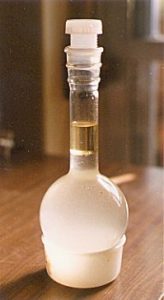
For the distillation of essential oils, you will have to use a 6-litre alembic with a 2-litre recipient with a high neck. Essential oil can only be distilled from plants that possess it, such as Eucalyptus (Eucaliyptus Globulus). For you “to become handy at it”, distill the Eucalyptus plant, because it is very easy to get the oils from it, as well as for the amount of essential oil that it contains. The leaves of the adult branches contain 1.2% to 3% of essential oil.
Cut some branches of Eucalyptus and remove the leaves, one by one. Put them in an alembic until it reaches the height of the neck of the cucurbit. Place the cucurbit on an oven and, pour onto the leaves 3 litre of water the source. Place the thermometer, the protection cone and, finally, the helm after you have applied silicon on all the joints. Adapt to the beak a reducer with air hole and this one to a matrass (receiver) with plane bottom having a neck of more than a transverse hand of height.
First, heat up to a moderate temperature, of about 50 degrees C, for the space of one hour and, only then, will you increase the temperature to about 100 degrees C. After some time, you will notice, inside the helm, tiny globules of essential oil that will run down the throat towards the beak and in to the recipient together with the distilled water.
Continue to distil uninterrupted, to the same temperature, but having the caution of verifying if the helm doesn’t heat up too much. If it becomes so warm that you could not place your hand on the top, then reduced the temperature. When the distillation reaches more than half of the height of the belly of the recipient, you can observe a thin oleaginous layer upon the water, with the thickness of 2 or 3 mm. Continue the distillation until the essential oil reaches about half of the receiver’s neck. Then, turn off the oven. With the remaining temperature, your distillation will reach the top of the recipient.
Observe that the essential oil doesn’t surpass the upper level of the receiving vase, because, if that happens, the oil will get lost through the air hole of the adapter. You will have distilled 20 or 30 ml of essential oil that you will remove through the recipient neck with a syringe, and keep in a glass flask tightly closed and sheltered from the light. Leave your alembic to cool down and remove the helm. Remove the cucurbit from the oven and, with a hook of very strong wire, remove all of the eucalyptus leaves from the cucurbit.
Repeat the process again, using the distilled water that was in the recipient, being, just necessary to increase to more than 1 litre. The same process will be applied to all the other plants that contain essential oils. It is evident that not all plants have the same amount of oil, and that the revenue will be different for each plant, although the extraction process will always be the same.
Rubellus Petrinus is a Portuguese alchemist who offers an excellent multi-language website devoted to the operative and speculative aspects of alchemy at http://planeta.clix.pt/petrinus/alchemy-e.htm.)
Alchemy Lectures and Workshops
Crucible 2001: An Alchemical Adventure
Crucible 2001 is a jump-in-the-fire event for anyone interested in creative transformation. The alchemical adventure will be held on Saturday, October 13, at the luxurious Delta King Hotel, on the riverfront in the heart of old Sacramento. Hosted by author and practicing alchemist Dennis William Hauck, this intensive multimedia event will focus on the practical and spiritual methods the alchemists actually used for the transformation of body, mind, and soul. Demonstrations, experiments, meditations, and other techniques will make these principles come alive in participants. Before any metal becomes gold, it must be exposed to the fire of the crucible! The Delta King is a five-story, 300-foot-long, completely refurbished riverboat with eight large meeting rooms, a comfortable bar/lounge, an award-winning restaurant, and spacious staterooms. Built in 1928, it was renovated in 1999 to become what U.S. Today calls “a unique meeting place with AAA five-diamond ratings.” Admission is $79 ($99 after August 1). For a free brochure, fill out the online Information Request Form. To use a credit card to register now, click Register Online.
Mystical Egypt and the Path to Immortality
This international conference on “Mystical Egypt and the Path to Immortality” will be held in Cairo, Egypt, from November 6 to 11. There will be a Egypt tour and Nile cruise after the event that lasts from November 10 to 18. Speakers include the following authors: John Anthony West is a writer and scholar, and author of The Traveler’s Key to Ancient Egypt. His previous book, Serpent in the Sky: The HighWisdom of Ancient Egypt is an exhaustive study of the revolutionary egyptological work of the French mathematician R.A. Schwaller de Lubicz. Dennis William Hauckwrites and lectures on the universal principles of physical, psychological, and spiritual perfection to a wide variety of audiences that range from scientists and business leaders to religious and New Age groups. He is the author of The Emerald Tablet: Alchemy for Personal Transformation and numerous translations of old alchemy manuscripts. Normandi Ellis is an author and poet, most well known for her poetic transliteration of the Egyptian Book of the Dead, Awakening Osiris. Among her other works are: Feasts of Light (the Egyptian Goddess festivals) and Dreams of Isis. Marc Amaru Pinkham is a metaphysical researcher and author of The Return of the Serpents of Wisdom and Conversations with the Goddess. Nicki Scully is a metaphysical teacher and author of The Golden Cauldron: Shamanic Journeys on the Path of Wisdom and Tribal Alchemy. For complete conference and tour information, click Cairo Conference.
EDITORIAL
From the Editor (Dennis William Hauck)
Having just returned from a three-week trip to Egypt, I am once again having difficulty readjusting to things in our modern world. The main ingredient that seems to be missing is the spiritual component that connects us to the perfection of the Above. In Egypt, the east bank of the Nile is for the living, for building grimy cities and factories, for buying and selling things, for all the practical and temporary accouterments of the world. Nothing is built to last on the east bank, and most of the dwellings are simple brick buildings that always seem to be in some phase of construction or destruction. But to find the spiritual component, all you have to do is look across the Nile to the west bank. It is the spiritual realm awaiting us, the place where even the sun goes when it dies to the world. The west bank is for tombs, pyramids, monuments, and things built to last forever. It is the eternal realm, the dwelling place of the gods, and it is just across the river. In ancient times, no one was allowed to live or farm on the west bank. It was reserved for the gods. I miss that clear demarcation between the temporal and the eternal. I miss that constant reminder that there exists an Above that determines our reality Below.
Submissions
Please submit your articles on any aspect of alchemy. We are looking fora biographies, historical articles, practical laboratory work, spagyric recipes, philosophical pieces, experiences in personal transformation, spiritual insights, Hermeticism, Gnosticism, book reviews, film and video reviews, website reviews, artwork, etc. Please submit your material or queries to the Alchemy Journal, P.O. Box 22201, Sacramento, CA 95822-0201. You may also submit materials via email to the Editor or to the Assistant Editor, Tiffany-Nicole Hill at [email protected].
Acknowledgements
“Alchemy: The Cosmological Yoga” by Maurice Aniane is from an article of the same name that first appeared in Material for Thought magazine, San Francisco, Califorrnia in Spring 1976.
Subscriptions
The Alchemy Journal is posted bimonthly at the Alchemy Lab website on the journal archives page at www.AlchemyLab.com/journal.htm. To subscribe to the journal, send a blank email to [email protected].