Alchemy Electronic Dictionary: Find Out the Meaning of Arcane Words and Ciphers Instantly!
Alchemy Electronic Dictionary
To find out the meaning of a word, select the beginning letter:
A B C D E F G H I J K L M N O P Q R S T U V W X Y Z
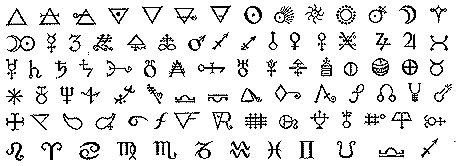
Or select the symbol for which you would like to see a definition:
For Alchemy Lab website assistance, click help.
- ablution
- The process of washing a solid with a liquid, usually in water. Spiritually and psychologically, it is facing one’s emotions and letting feelings flow, so that innocence and purity can be restored.
- Aion
- (see Ouroboros)
- Air
- Air is one of the Four Elements of alchemy. Air in the alchemical sense carries the archetypal properties of spirit into the manifested world. It is associated with the operation of Separation and represented by the metal Iron.
- alchemy
- The word is derived from the Arabian phrase “al-kimia,” which refers to the preparation of the Stone or Elixir by the Egyptians. The Arabic root “kimia” comes from the Coptic “khem” that alluded to the fertile black soil of the Nile delta. Esoterically and hieroglyphically, the word refers to the dark mystery of the primordial or First Matter (the Khem), the One Thing through which all creation manifests. Alchemy, then, is the Great Work of nature that perfects this chaotic matter, whether it be expressed as the metals, the cosmos, or the substance of our souls.
- alembic
- The upper part of a still; a still-head. The term is often used to refer to a complete still. (see cucurbute; Distillation)
- alkahest
- The alkahest is the power from Above that makes possible alchemical transformation. The word is usually translated as “universal solvent,” which alludes to the ability of the alkahest to dissolve or reduce all physical matter to its basic essence. With metals, this meant transmuting them to their purest form, which was gold. In the human body, this meant the creation or revealing of a golden body of consciousness, the Astral Body.
- aludel
- A pear-shaped earthenware bottle, open at both ends. It was used as a condenser in the sublimation process and thus came to signify the end-stages of transformation. Also called the Hermetic Vase, the Philosopher’s Egg, and the Vase of the Philosophy.
- amalgam
- The amalgam is a solid metal formed by the combination of mercury with gold, silver, lead, or other metals.
- angel
- An angel in alchemical treatises symbolizes sublimation or the ascension of the volatile principle.
Ankh
The Ankh is a hieroglyphic character used by Egyptian alchemists to denote the ascendancy of the life force or spirit (the circle) over the material world (the cross). In other words, through crucifixion, the soul rises and is reborn on a higher level. Its use dates back over 3,000 years and is a symbolic rendition of the principles expressed in the Emerald Tablet. In its design, the circular One Mind projects downward into the One Thing, while the lateral manifested world on which we are crucified is indicated by the horizontal bar.
animals
Animals are often used to symbolize the basic components and processes of alchemy. They may be used to symbolize the four Elements such as the lion or ox (Earth), fish or whales (Water), eagles (Air), or salamanders or dragons (Fire). Aerial animals generally indicate volatile principles, while terrestrial animals indicate fixed principles. Whenever two animals are found, they signify Sulfur and Mercury or some relationship between the fixed and the volatile.
The metal antimony symbolizes the animal nature or wild spirit of man and nature, and it was often symbolized by the wolf. Alchemist Basil Valentine named the metal, after feeding it to some monks in a Benedictine monastery. The monks got violently ill and some even died, hence the Latin name that means “anti-monk.” Spiritually too, monks feel most threatened by their own animal nature. Oddly enough, the Tincture of Antimony cures venereal diseases.
Apollo
References to the Greek god Apollo signify the Sun as spirit or solar consciousness.
- aqua fortis
- Aqua fortis is Latin for “strong water” and refers to nitric acid. Various grades of aqua fortis were prepared depending on the length of Distillation, which concentrated the acid.
- aqua regia
- A mixture of aqua fortis (“strong water,” i.e., nitric acid) and spiritus salis (“spirit of salt,” i.e., hydrochloric acid) produces aqua regia (“royal water” — so named because it can dissolve gold). It was first prepared by distilling common salt with aqua fortis.
- aqua vitae
- The “living water” or water “with spirit.” An aqueous alcohol concentrated by one or more Distillations.
- arcana
- The arcana (“magical secrets”) are archetypal influences that transcend space and time. According to the ancient text Archidoxies, the arcana are pre-existing powers that “have the power of transmuting, altering, and restoring us.” In this view, the arcana are the secret workings of the mind of God, the logos of the Greeks or what the alchemists referred to as the thoughts of the One Mind. In the Tarot, the arcana are represented by symbolic drawings that the reader tries to work with through meditation. In the Cabala, the arcana are represented by the esoteric properties of the letters of the Hebrew alphabet, energies that the cabalist tries to work with in the Tree of Life. In the in the ancient Chinese system of divination, the I Ching, the arcana are represented by the sixty-four trigrams, each with its own properties and influences. The alchemists believed the arcana were expressed on all levels of reality — from chemical compounds to our innermost moods and desires.
- Arcanum Experiment
- The early alchemists divided their chemicals into major and minor arcana. The major arcana consisted of the four compounds: Vitriol, Natron, Liquor Hepatis, and Pulvis Solaris. Three out of the four consisted of dual ingredients that were easily separable. Vitriol could be broken down into sulfuric acid and iron. Natron appeared as sodium carbonate and sodium nitrate. Pulvis Solaris was made up of the red and black varieties. Thus, the seven chemicals comprising the minor arcana were: Sulfuric Acid, Iron, Sodium Carbonate, Sodium Nitrate, Liquor Hepatis, Red Pulvis Solaris, and Black Pulvis Solaris. The alchemists believed that these secret chemicals could be combined in the Arcanum Experiment, the single laboratory experiment that would demonstrate the archetypal forces and evolution of the universe. Ideally, such an experiment should succeed on many levels, not only corroborating the deepest philosophical and psychological principles, but also providing concrete evidence of their veracity. The Arcanum Experiment exposed the hidden principles connecting heaven and earth, offering a framework in which to explain both microcosmic and macrocosmic events.
- athanor
- From the Arabic word “al-tannur” (oven), the athanor is the furnace used by the alchemists to perfect matter. Built of brick or clay, the athanor usually was shaped like a tower with a domed roof and was designed to keep an even heat over long periods of time. The alchemists considered it an incubator and sometimes referred to it as the “House of the Chick.” Symbolically, the athanor is also the human body and the fire of bodily metabolism that fuels our transformation and the ultimate creation of a Second Body of light. The mountain is a symbol for the athanor, since the perfection of the metals takes place under the guise of Nature within mountains. Sometimes a hollow oak tree is used to symbolize the atanor.
- Azoth
- The term “Azoth” is formed from the first and last letters of the English alphabet (“a” and “z”), which stand for the beginning and end of all creation — the alpha and omega of the Greek philosophers, the aleph and tau of the Hebrew cabalists. Therefore the Azoth is the ultimate arcanum, the universal spirit of God in all created things. The alchemists believed that the liquid metal mercury carried the signature of this omnipotent archetypal spirit.
Back to Top
– B –
- The Bain Marie is a warm alchemical bath. Chemically, it is a double-boiler in which a container of water is suspended in a simmering cauldron. Psychologically, it is the gentle warmth of emotionally centered meditation used in the Dissolution process. The Bain Marie was named after Maria Prophetissa, a Jewish alchemist who wrote much about the methods and equipment of the Water operations of Dissolution and Distillation.
- balsam
- A balsam is a resinous or waxy semi-solid compound that captures the essence of a liquid medicine or perfume. To Paracelsus, the balsam was the “interior salt” that protected the body from decomposition, and earlier alchemists considered the Balsam of the Elements to be the Quintessence, the result of the Conjunction of alchemical principles. Because of it amalgamating ability, mercury was considered the balsam agent of the metals. In the chemical arcana, Liquor Hepatis mixed with fat or wax was known as the Balsam of the Soul.
- Basilisk
- The Basilisk is a symbolic alchemical creature said to have the head of a bird and the body of a dragon. The wingless serpentine animal was hatched from a hermaphroditic cock’s egg and nursed by a serpent. Psychologically, the Basilisk represents the melding of our higher and lower natures in Conjunction, a process that must be continued in the next three operations of alchemy for this “Child of the Philosophers” to become the Living Stone of the fully integrated Self. Biologically, the Basilisk represents the mammalian embryology, the genetic replaying of the stages of evolution within the egg or womb. The Basilisk also has chemical connotations, which probably have to do with a metallurgical process involving cinnabar.
- baths
- Baths in alchemy symbolize the Dissolution process in which the metals are cleansed and purified.
- birds
- Ascending birds indicate the volatilization of compounds or their sublimation. Descending birds indicate the fixation of compounds or their condensation and precipitation. Birds shown both ascending and descending indicate the process of Distillation.
- bezoar
- Some chemical compounds, such as sulfur auretum when mixed with either red mercuric oxide or black antimony, clump together inseparably as soon as they are mixed together. The alchemists considered such compounds to be chemical bezoars, which are hard clumps of undigested food or solid balls of hair sometimes found in the intestines. In the Middle Ages, physicians thought the strange mass protected people from poisons and actually prescribed it to their patients. Egyptian priests discovered bezoars during the preparation of mummies and believed the hard balls were magical pills formed by the large serpent in man (the intestines). Some evidence suggests that the Egyptians also looked for a similar pill in the small serpent in man (the brain) and found it there in the form of the pineal gland. This pine-shaped gland is imbedded with tiny crystals of dark melanin, and could explain the Egyptian pinecone emblems and the origin of the caduceus itself. And, in the same way that bezoars were formed in the serpentine contours of the intestines, so was gold formed in the bowels of the earth: gold was considered a mineral bezoar.
- Black Phase
- The Black Phase (or Melanosis) is the first stage in alchemy. It phase begins with the operation of Calcination and lasts through the Putrefaction stage of Fermentation.
- brimstone
- (see Sulfur)
Back to Top
– C –
- caduceus
- The caduceus is the magical staff of Hermes, the Messenger of the Gods and revealer of alchemy. The staff is entwined by two serpents representing the solar and lunar forces. Their union is the Conjunction of alchemical principles and their offspring, if it lives, is the Stone. This Stone is represented as a golden ball with wings at the top of the caduceus.
- Calcination
- The first operation in alchemical transformation. It is denoted by the symbol for the first sign of the zodiac, Aries.
- Ceration
- A part of the Fermentation process during which a waxy substance flows from the putrefied matter. This is the Ferment, the precursor of the Stone. Ceration is the softening or mollification of a hard material to change it into a more waxy state; covering with wax or salve.
- child
- A naked child symbolizes the innocent soul. In alchemy, the child is the offspring of the King and Queen, the result of their marriage or union. A child crowned or clothed in purple robes signifies Salt or the Philosopher’s Stone.
- cibation
- Cibation is the addition of new material to the contents of the crucible. During Dissolution, it requires adding liquid to the desiccated matter at precisely the right moment.
- cinnabar
- Cinnabar is the bright red ore of mercury sulfide. Known as “Dragon’s Blood,” the roasted rocks emit a thick reddish smoke, as pure glistening mercury oozes from cracks. Psychologically, cinnabar represents the hardened habits and terrestrial marriages of soul and spirit that must be broken asunder in Calcination to free the essences with which the alchemist intends to work.
- circle
- The circle or sphere is symbolic of unity, the One Mind of god. It is mathematically and psychologically an “irrational” experience beyond the duality of reason.
- Coagulation
- The seventh and last operation in alchemical transformation is Coagulation.
- Cohobation
- A kind of Distillation in which the distillate is poured back into its residue; a method of redistillation.
- Conjunction
- Conjunction is the fourth operation in alchemical transformation. It is the coming together of the opposing archetypal forces of the Sun and Moon or the King and Queen.
- Congelation
- A loose or temporary Conjunction of opposites; a mixture in which a liquid is gelled or made semi-solid; intercourse. The process is represented by the sign for the constellation of Taurus.
- copper
- Copper is one of the seven metals of alchemy. Copper (and sometimes bronze and brass) is associated with the operation of Conjunction and the element Earth.
croslet
(see crucible)
crown
The crown symbolizes the successful completion of an alchemical operation or the achievement of a magisterium. It also signifies chemical royalty or the perfection of a metal.
crows
Crows are the symbols of the black phases of Calcination and Putrefaction.
The crucible is the melting vessel of the alchemists. It is made of inert material such as porcelain and can withstand great heat. Used to liquefy the metals.
- curcurbite
- The lower part of a still, containing the original liquid. It is made of glass or earthenware and was also known as a “gourd” on account of its shape; a receiver. (see alembic; Distillation)
cupel
A small cup or dish made of bone-ash or other porous and infusible material. Cupellation is the process of heating a substance in a cupel in a current of air, such as done in the refining of silver and gold.
Back to Top
– D –
- dew
- Dew is symbolic of divine incarnation or manifestation from Above. Alchemists believed natural dew contained the divine Salt (thoughts of the One Mind) that could transform the Sulfur and Mercury of the First Matter. In many ways, dew represented the Elixir or contents of the cup of God, the Holy Grail.
- Diana
- Appearances of the Greek goddess Diana in alchemical drawings and treatises signify the Moon and Lunar consciousness.
- Distillation
- Distillation is the sixth operation in alchemical transformation. Denoted by the symbol for the constellation Virgo. It is essentially a process of concentration, no matter on what level (physical, mental, or spiritual) it occurs.
- Dissolution
- The second operation in alchemical transformation is Dissolution. The process of dissolving a solid in a liquid; the reduction of a dry thing in water. Represented by the sign for the constellation of Cancer.
- dogs
- Dogs signify primitive matter, natural sulfur, or material gold. A dog being devoured by a wolf symbolizes the process of purifying gold using antimony.
- dove
- The dove is a symbol of renewed spirit or infusion of energy from Above. Chemically, it signifies the change from the Black Stage to the White Phase of transformation.
- dragon
- The dragon in flames is a symbol of fire and Calcination. Several dragons fighting is symbolic of Putrefaction. Dragons with wings represent the volatile principle; dragons without wings represent the fixed principle. A dragons biting its own tale is the Ouroboros and signifies the fundamental unity of all things.
Back to Top
– E –
- eagle
- The eagle is always a symbol of volatilization. For instance, an eagle devouring a lion indicates the volatilization of a fixed component by a volatile component.
- Earth
- Earth is one of the Four Elements of alchemy. Earth in the alchemical sense carries the archetypal properties of manifestation, birth, and material creation. It is associated with the operation of Conjunction and represented by the green ore of copper.
- Elixir
- The Elixir of the alchemists is essentially a liquid version of the Philosopher’s Stone and has the same ability to perfect any substance. When applied to the human body, the Elixir cures diseases and restores youth.
- egg
- The egg is symbolic of the hermetically sealed vessel of creation. Stoppered retorts, coffins, and sepulchres represent eggs in many alchemical drawings.
Back to Top
– F –
- Fermentation
- The fifth operation in alchemical transformation is Fermentation. It is represented by the sign for the constellation of Capricorn.
- Filtration
- A kind of Separation, in which material is passed through a sieve or screen designed to allow only pieces of a certain size to pass through. The operation is represented by the sign for the constellation of Sagittarius, the Archer.
- Fire
- Fire is one of the Four Elements of alchemy. Fire in the alchemical sense carries the archetypal properties of activity and transformation. It is associated with the operation of Calcination and represented by the metal lead.
- Fixation
- The process of stabilizing and incarnating a substance; depriving a substance of its volatility or mobility to congeal or combine it. The process is represented by the sign for the constellation of Gemini.
- fountain
- The alchemical Fountain of Fountains is a symbol of the Ouroboros. Three fountains represent the three principles of Sulfur, Mercury, and Salt. The King and Queen sitting in a fountain signifies a bath or the Water operations of Dissolution and Distillation.
Back to Top
– G –
- Geber
The Latin name of Jabir ibn Hayyan (721 – 815 A.D.). He is the father of both Islamic and European alchemy. He knew of the existence of the Emerald Tablet and spread the doctrines of the Four Elements and the Mercury-Sulfur theory of the generation of the metals.
- gold
- Gold is the most perfect of the metals. For the alchemist, it represented the perfection of all matter on any level, including that of the mind, spirit, and soul. It is associated with the operation of Coagulation.
- grain
- Grain, seeds, or grapes symbolize the matter of the Stone.
- Griffin’s Egg
- The griffin is a half-lion and half-eagle creature that symbolizes the Conjunction of the fixed and volatile principles. An allusion to the Vessel of Hermes.
Back to Top
– H –
- Hermaphrodite
- The Hermaphrodite represents Sulfur and Mercury after their Conjunction. Rebis (something double in characteristics) is another designation for this point in the alchemy of transformation.
Back to Top
– I –
- Iosis
- (see Purple Phase)
Back to Top
– J –
- Jabir
- (see Geber)
- Jungian Alchemy
- Psychiatrist Carl Gustav Jung rediscovered the images and principles of alchemy surfacing in the dreams and compulsions of his patients and began a lifelong study of the subject. He concluded that alchemical images explain the archetypal roots of the modern mind and underscores a process of transformation leading to the integration of the personality.
Back to Top
– K –
- King
- The King in alchemy represents man, solar consciousness, or Sulfur. The King is naked in the early operations of alchemy and regains his royal robes at the end of his transformation. The King united with the Queen symbolizes Conjunction.
Back to Top
– L –
- lead
- Lead is the first and oldest of the seven metals of alchemy. It is associated with the operation of Calcination.
Leukosis
(see White Phase)
Liquor Hepatis
Liquor Hepatis was the name given to a sulfurous liquid used by the alchemists. Considered the arcanum of the soul, Liquor Hepatis was prepared by distilling a solution of sulfur, lime, and sal ammoniac. The early alchemists secured lime (calcium oxide) by heating limestone and made sal ammoniac (ammonium chloride) by gently heating camel dung in sealed containers. The distillation for Liquor Hepatis produced a combination of hydrogen sulfide and ammonia gases. Since no solids precipitated, alchemists considered this an ascending reaction only. That was a significant fact to the Egyptians, who associated the Liquor with the soul. They believed the soul resided in the liver, and the reddish-brown color of Liquor Hepatis convinced them they had isolated the soul’s essence. The name comes from “hepar,” the Greek word for liver. The Liquor exuded an unnatural, pungent odor that the alchemists found quite mysterious. They assumed it was due to an ethereal presence concealed in the sulfur and activated by the fertile principle in ammonia. To the Egyptians, the odor symbolized a soul or a spiritized presence hidden within the liquid. They solidified that presence by adding wax and fat to Liquor Hepatis and turning it into a thick paste. The emulsion became known as the Balsam of the Alchemists or Balsam of the Soul. The possibility of coagulating an invisible potential into a second body, like a balsam, became a basic tenet of alchemy.
The litharge (or letharge) is the left-over scum, spume, or ashes of a metallic operation.
Back to Top
– M –
- Magnesia
- Magnesia was a mystical term to the alchemists that denoted the primordial transforming substance in the universe. It was one of many symbols used to describe the central mystery of alchemy that was never to be spoken of in common wording.
- matrass
- A round-bottomed flask with a very long neck. Also called a “bolt-head.”
- Melanosis
- (see Black Phase)
- menstruum
- An alchemical term meaning a solvent or alkahest having both the power to dissolve and coagulate at the same time. Based on the belief that the ovum takes its life and form from the menses, the menstruum was also referred to the as the Mercury of the Philosophers.
- Mercury
- Mercury, called quicksilver by the ancients, is a liquid metal that could be found weeping through cracks in certain rocks or accumulating in small puddles in mountain grottos. It was also obtained by roasting cinnabar (mercury sulfide). The shiny metal would seep from the rocks and drip down into the ashes, from which it was later collected. The early alchemists made red mercuric oxide by heating quicksilver in a solution of nitric acid. The acid, which later alchemists called “aqua fortis,” was made by pouring sulfuric acid over saltpeter. The reaction of quicksilver in nitric acid is impressive. A thick red vapor hovers over the surface and bright red crystals precipitate to the bottom. This striking chemical reaction demonstrated the simultaneous separation of mercury into the Above and the Below. Mercury’s all-encompassing properties were exhibited in other compounds too. If mercury was heated in a long-necked flask, it oxidized into a highly poisonous white powder (white mercuric oxide) and therapeutic red crystals (red mercuric oxide). Calomel (mercury chloride) was a powerful medicine, unless it was directly exposed to light, in which case it became a deadly poison. When mixed with other metals, liquid mercury tended to unite with them and form hardened amalgams. These and other properties convinced alchemists that mercury transcended both the solid and liquid states, both earth and heaven, both life and death. It symbolized Hermes himself, the guide to the Above and Below.
- Multiplication
- A process of Distillation in which the power of transmutation is concentrated; an increase in the amount of the Stone as obtained from its pristine form. It is represented by the sign for the constellation of Aquarius.
Back to Top
– N –
- Natron
- Natron means salt. To the early alchemists, however, the word Natron stood for the basic principle in all salt formation and the creation of bodies in general. The Egyptians accumulated the white salts formed from the evaporation of lakes and used them to preserve mummies. Known as soda ash (sodium carbonate), the oldest deposits are in the Sinai desert. Another naturally-occurring sodium compound mined by the Egyptians was cubic-saltpeter (sodium nitrate). The alchemists referred to both these salts as Natron (from the Arabic word for soda ash), because they suspected that both had a common signature or archetypal basis.
Back to Top
– O –
- Ouroboros
- The Ouroboros (or Uroboros) is the symbolic rendition of the eternal principles presented in the Emerald Tablet. The great serpent devouring itself represents the idea that “All Is One,” even though the universe undergoes periodic cycles of destruction and creation (or resurrection). In Orphic and Mithraic symbology, the Ouroboros was called the Agathos Daimon or “Good Spirit” and was a symbol for the “Operation of the Sun.” In Greek terminology, the Ouroboros was the Aion, which Herakleitos likened to a child at play. To the Greeks, the Aion (from which our word “eon” is derived) defined the cosmic period between the creation and destruction of the universe.
Back to Top
– P –
- Pelican
- A circulatory vessel with two side-arms feeding condensed vapors back into the body. It has a fancied resemblance in shape to a pelican pecking at its breast.
- Philosopher’s Stone
(see Stone)
A process of Coagulation in which solid matter is created during a chemical reaction and falls out of solution.
- Projection
- The final stage of Coagulation in which the power of transformation is directed toward a body; the final process in making gold, in which the Stone or powder Stone (the powder of projection) is tossed upon the molten base metal to transmute it. It is represented by the sign for the constellation of Pisces.
- Pulvis Solaris
- Pulvis Solaris was the chemical arcanum that represented spirit. The “Powder of the Sun” was a mixture of two powders, Black Solaris and Red Solaris. Combining black antimony with sulfur auretum made Black Pulvis Solaris. Black antimony was a common sulfide of antimony, now known as stibnite. The mineral was smelted and ground fine. Pure sulfur auretum, or “golden sulfur,” was made by adding sulfuric acid to a dried mixture of sodium carbonate, sulfur, lime, and antimony. The reaction gave off hydrogen sulfide gas, while the sulfur auretum precipitated to the bottom of the container. Red Pulvis Solaris was made by combining sulfur auretum with a compound of mercury known as red mercuric oxide. Egyptian alchemists associated the serpent with the red mercuric oxide and referred to Red Pulvis Solaris as Pulvis Serpentum. Later alchemists became convinced that Red Pulvis Solaris was indeed the powder of projection that would enable them to transform virtually anything into pure gold.
- Purple Phase
- The Purple Phase (or Iosis) of the Great Work is the third and final stage of transformation. It is marked by the purpling or reddening of the material and occurs during the Coagulation operation.
- Putrefaction
- The first stage of the Fermentation operation; a digestion in which decomposing essences are reabsorbed. The process was represented by the symbol for the constellation of Leo.
Back to Top
– Q –
- Queen
- The Queen symbolizes woman, lunar consciousness, and Mercury. The Queen is naked during the early stages but regains her royal robes at the end of her transformation. The Queen united with the King is the operation of Conjunction.
- quicklime
- Quicklime is unslacked lime or calcium oxide. Calcium oxide is obtained by heating limestone, egg shells, or any material containing Calcium Carbonate, which is one of the seven arcana of alchemy.
- quicksilver
- (see Mercury)
- Quintessence
- The Quintessence is the fifth element with which the alchemists could work. It was the essential presence of something or someone, the living thing itself that animated or gave something its deepest characteristics. The Quintessence partakes of both the Above and the Below, the mental as well as the material. It can be thought of as the ethereal embodiment of the life force that we encounter in dreams and altered states of consciousness. It is the purest individual essence of something that we must unveil and understand in order to transform it.
Back to Top
– R –
- Rebis
- (see Hermaphrodite)
- retort
- The retort is a spherical container (usually glass) with a long neck or spout. It is used to distill or decompose solutions by the action of heat or acids.
Back to Top
– S –
- Salt
- Salt is the third heavenly substance in alchemy and represents the final manifestation of the perfected Stone. The Emerald Tablet calls it “the Glory of the Whole Universe.” For Paracelsus, Salt was like a balsam the body produced to shield itself from decay. It has also been associated with the Ouroboros, the Stone, and the Astral Body. In general, Salt represents the action of thought on matter, be it the One Mind acting on the One Thing of the universe or the alchemist meditating in his inner laboratory.
- Separation
- The third operation in the alchemy of transformation. Symbols of Separation include swords, scythes, arrows, knives, and hatchets. The operation is symbolized by the sign for the constellation of Scorpio.
- serpents
- Two serpents represent the opposing masculine and feminine energies of the Work. Three serpents stand for the three higher principles of Sulfur, Mercury, and Salt. Wingd serpents represent volatile substances; wingless serpents represent fixed substances. A crucified serpent represents the fixation of the volatile.
- silver
- Silver is one of the seven metals of alchemy. It is associated with the operation of Distillation.
- skeletons
- Skeletons signify the process of Putrefaction, on all the levels in which it occurs.
Soul in alchemy is the passive presence in all of us that survives through all eternity and is therefore part of the original substance (First Matter) of the universe. Ultimately, it is the One Thing of the universe. Soul was considered beyond the four material elements and thus conceptualized as a fifth element (or Quintessence).
Spirit in alchemy is the active presence in all of us that strives toward perfection. Spirit seeks material manifestation for expression. Ultimately, it is the One Mind of the universe.
square
The square or cube is symbolic of matter and the Four Elements of creation.
- Stone
- The Stone is the goal of the Great Work. It was viewed as a magical touchstone that could immediately perfect any substance or situation. The Philosopher’s Stone has been associated with the Salt of the World, the Astral Body, the Elixir, and even Jesus Christ.
- Sublimation
- The first stage of Coagulation, in which the vapors solidify; represented by the sign for the constellation of Libra. The vaporization of a solid without fusion or melting, followed by the condensation of its vapor in the resolidified form on a cool surface. The elevation of a dry thing by fire, with adherency to its vessel. The astrological symbol association with Sublimation is the sign of Libra, the scales.
- Sulfur
- Sulfur (Sulphur) is one of the three heavenly substances. It represents passion and will and is associated with the operation of Fermentation.
Back to Top
– T –
- tin
- Tin is one of the seven metals of the alchemists. It is associated with the operation of Dissolution and the element Water. Pewter (a mixture of lead and tin) represents a metallic state between the operations of Calcination and Dissolution.
three levels
The key to understanding alchemy is to realize that alchemical thought is extremely dynamic and takes places on three levels at once: the physical, the psychological, and the spiritual. Thus turning lead into gold meant not only physically changing the base metal into the noble metal, but also transforming base habits and emotions into golden thoughts and feelings, as well as transmuting our dark and ignoble souls into the golden light of spirit. By developing this ability to think and work on all three levels of reality at once (becoming “thrice-greatest”), the alchemists created a spiritual technology that applied not only to their laboratories but also to their own personalities and to their relationships with other people — and with God.
- tree
- Trees symbolize the processes of transformation. A tree of moons signifies the Lesser or Lunar Work; a tree of suns signifies the Greater or Solar Work.
- triangle
- The triangle represents the three heavenly principles or substances of Sulfur, Mercury, and Salt.
- trituration
- Grind a solid into a powder. Pulverize with a mortar and pestle. Crush. A process just after Calcination, when the ashes are ground into a fine powder for Dissolution.
Back to Top
– U –
- Uroboros
- (see Ouroboros)
Back to Top
– V –
- Vitriol
- Vitriol was the most important liquid in alchemy. It was the one in which all other reactions took place. Vitriol was distilled from an oily, green substance that formed naturally from the weathering of sulfur-bearing gravel. This Green Vitriol is symbolized by the Green Lion in drawings. After the Green Vitriol (copper sulfate) was collected, it was heated and broken down into iron compounds and sulfuric acid. The acid was separated out by distillation. The first distillation produced a brown liquid that stunk like rotten eggs, but further distillation yielded a nearly odorless, yellow oil called simply Vitriol. The acid readily dissolves human tissue and is severely corrosive to most metals, although it has no effect on gold. White Vitriol is zinc sulfate; Blue Vitriol is copper sulfate.
Back to Top
– W –
- Water
- Water is one of the Four Elements of alchemy. Water in the alchemical sense carries the archetypal properties of cleansing and purification. It is associated with the operation of Dissolution and represented by the metal tin.
- White Phase
- The White Phase (Leukosis) is the second stage of the Great Work and takes place during Distillation.
- wolf
- (see antimony)
Back to Top
– X –
- Xanthosis
- (see Yellow Phase)
Back to Top
– Y –
- Yellow Phase
- The Yellow Phase (or Xanthosis) of alchemy is an intermediate stage that takes place between the Black and White phases of the Great Work. The term was used by Alexandrian alchemists to describe changes that took place during the Fermentation operation.
Back to Top
– Z –
- Zodiac
- According to the Doctrine of Correspondences in the Emerald Tablet (“As Above, so Below”), the stars must find expression on earth and in mankind. In alchemy, it was essential to consult the zodiac before commencing any of the major operations.
Back to Top
- How to navigate the Alchemy Lab. The alchemists believed there were basically just two ways of knowing reality and that is how this website has been organized. The first way of knowing is the rational, deductive, argumentative, intellectual thinking that is the hallmark of science and our patriarchal Western culture. The alchemists called this Solar Consciousness and assigned it many code words, such as the King, the Sun, Sulfur, Spirit, the Father, and ultimately, the One Mind. Throughout this website, whenever the material involves left-brain solar activity like lists, linear thought, schematics, formulae, arguments and logic, the icon used will be the Solar button. The alchemists called the other way of knowing Lunar Consciousness. This non-rational, image-driven, intuitive way of thinking is an accepted part of mysticism and religion. Among its many symbols are the Queen, the Moon, the metal Mercury, the Soul, the Holy Ghost, and ultimately, the One Thing. Throughout this website, whenever the material involves lunar, nonlinear right-brain activity like drawings, paintings, mandalas, symbols, meditations, and music, the icon will be the Lunar button. Try to use both ways of knowing when trying to understand alchemical topics. The alchemists believed there were basically just two ways of knowing reality and that is how this website has been organized. The first way of knowing is the rational, deductive, argumentative, intellectual thinking that is the hallmark of science and our patriarchal Western culture. The alchemists called this Solar Consciousness and assigned it many code words, such as the King, the Sun, Sulfur, Spirit, the Father, and ultimately, the One Mind. Throughout this website, whenever the material involves left-brain solar activity like lists, linear thought, schematics, formulae, arguments and logic, the icon used will be the Solar button. The alchemists called the other way of knowing Lunar Consciousness. This non-rational, image-driven, intuitive way of thinking is an accepted part of mysticism and religion. Among its many symbols are the Queen, the Moon, the metal Mercury, the Soul, the Holy Ghost, and ultimately, the One Thing. Throughout this website, whenever the material involves lunar, nonlinear right-brain activity like drawings, paintings, mandalas, symbols, meditations, and music, the icon will be the Lunar button. Try to use both ways of knowing when trying to understand alchemical topics.
- How to work with fractal diagrams. Fractal diagrams are computer images that are generated through the formulae of the mathematics of chaos. As such, they represent the “irrational” components of alchemy or its First Matter. To work with fractal diagrams, it is necessary to allow the mind to become drawn in by them and make use of one’s intuitive feelings rather than thought processes.
- Printing Problems. If only part of a page from the Alchemy Lab prints for you, go to your browser File menu and choose Print. In the “Print Frames” box, make sure that the option “As Laid Out on the Screen” is selected. If this does not work, select the Page Setup option and change the printout style. Choose “Landscape” for wider printouts and “Portrait” for higher printouts.
LEARN MORE: Related Topics | On the Internet