
Origins of Alchemy
Origins of Alchemy
Esoteric Origins | Shamanic Origins
A Look at the Cultural Birth of Alchemy
by Lynn Osburn ([email protected])
Esoteric Origins of Alchemy
Early alchemists Zosimus and Isis said alchemical knowledge came from fallen angels sexually attracted to human women. The early Christian church fathers believed them and claimed the angels had sinned against the orders of god. Who were these angels?
The Book of Enoch (Enoch 1), the Book of the Secrets of Enoch (Enoch 2) and the Book of Jubilees contain more details about the fallen angels referred to in Genesis. Enoch 2 was probably written by a Hellenistic Jew in the first century CE. Enoch 1 and the Book of Jubilees are Jewish works of the intertestamental period written down in the second century BCE. The information contained in them is much older than the date of these manuscripts.
Enoch was the great grandfather of Noah. Genesis 5: 22-24 says, “And Enoch walked with God after he begat Methuselah three hundred years, and begat sons and daughters: And all the days of Enoch were three hundred sixty and five years: And Enoch walked with God: and he was not; for God took him.” The Books of Enoch describe how he was taken to the heavens after a tour of the earth: “The Lord spoke, ‘Have no fear, Enoch, good man and scribe of goodness. Come hear my voice. Go speak to the Watcher of Heaven, who have sent you to intercede for them. Tell them: You should intercede for men, and not men for you. Why did you leave lofty, holy Heaven to sleep with women, to defile yourselves with the daughters of men and take them as your wives…?’” After God’s rhetorical admonition against his lustful yet loving angels He said to Enoch, “As for the Watcher who sent you to intercede for them, tell them: ‘You were in Heaven but the mysteries were not revealed to you. You knew worthless ones, and in the hardness of your hearts you revealed these to women, and through these secrets women and men work much evil [on] earth.’ Say to them, ‘You have no peace.’”[1]
After his audience with God, angels including the archangel Uriel took Enoch on journeys through hell and heaven. From there the angel Raguel took him to the Seven Mountains in the Northwest and the Tree of Life. “Fragrant trees encircled the throne. Among them was a tree like no other. Its fragrance was beyond all fragrance, and its leaves and blooms and wood never withered….” Michael, the leader of the angels tells Enoch, “As for this fragrant tree, no mortal is permitted to touch it till the great judgment….”[2] Enoch was instructed by the Lord to write down what had been revealed to him and to teach the people this wisdom. He did so in 366 books. Scholars believe the meaning of the name Enoch stems from a variant of the Hebrew root connoting “to train, to educate.”[3]
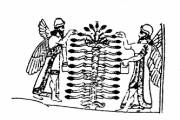
< Bearded angels picking buds from the Tree of Life energized by Water of Life within.
Scholars have been able to verify the general historical accuracy of the Old Testament by comparing the biblical episodes to much older parallel chronicles written in cuneiform characters on clay tablets from the ancient Mesopotamian kingdoms of Assyria and Babylonia. The oldest of all are from Sumer. Shumer is “Land of the Watchers” in Akkadian, the root semitic language used by the Assyrians and Babylonians.
The Sumerian King List records all the rulers of earth back over 400,000 years. This huge stretch of time coupled with reigns into the thousands of years has caused most historians to reject its accuracy. However all the early rulers were gods — immortals. The King List does record the reign of Enmeduranki whose name meant “ruler whose me connect Heaven and Earth.” A tablet described by W.G. Lambert tells a story similar to Enoch’s: “Enmeduranki [was] a prince in Sippar, beloved of Anu, Enlil and Ea. Shamash in the Bright Temple appointed him. Shamash and Adad [took him] to the assembly [of the gods]… They showed him how to observe oil on water, a secret of Anu, Enlil and Ea. They gave him the Divine Tablet, the kibdu secret of Heaven and Earth… They taught him how to make calculations with numbers.”[4] Anu, Enlil, Ea, Shamash and Adad were Sumerian gods called Anunnaki meaning “those who from Heaven to Earth came.”
A tablet referred to as CBS 14061 describes an incident paralleling the Enochian marriage of an angel to a human woman. The tablet tells of a young god named Martu who fell in love with the daughter of the high priest of Ninab. Martu complained to his goddess mother, “In my city I have friends, they have taken wives. I have companions, they have taken wives. In my city, unlike my friends, I have not taken a wife; I have no wife, I have no children.” Martu’s mother asked him if the woman he desired “appreciated his gaze.” Then the goddess gave her consent to the marriage. Enlil the leader of the gods on Earth became increasingly upset over the pollution of Anunnaki blood by these marriages and over the young Anunnaki gods becoming more interested in freedom and idyllic life on earth than taking orders from Enlil. He said “I will destroy the Earthling whom I have created off the face of the Earth.”[5]

The peoples of ancient civilization, Sumerians, Egyptians, Akkadians, Assyrians, Babylonians, Hittites, Hebrews etc., in their sacred writings all describe gods that physically dwelt on earth. This was aside from their writings on philosophy and mysticism. According to the Sumerians these gods came from the planet Nibiru, “planet of the crossing;” the Assyrians and Babylonians called it Marduk, after their chief god. The Sumerians never called the Anunnaki, “gods.” They were called din.gir, a two syllable word. Din meant “righteous, pure, bright;” gir was a term used to describe a sharp-edged object. As an epithet for the Anunnakidingir meant “righteous ones of the bright pointed objects.”[6] 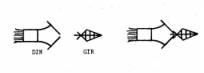
< The Sumerian pictograph for the word looks like a two-staged rocket with a pointed capsule at the top.
Sumerian texts break up history into two epochs divided by the great Deluge — the Biblical Flood. After the waters receded “‘the great Anunnaki who decree the fate’ decided that the gods ‘were too lofty for mankind.’ The term used — elu inAkkadian — means exactly that: ‘Lofty Ones;’ from it comes the Babylonian, Assyrian, Hebrew, and Ugaritic El — the term to which the Greeks gave the connotation ‘god.’”[7]
Returning to Genesis chapter six, after the sons of God took human wives, verse four continues: “There were giants in the earth in those days; and also after that, when the sons of God came in unto the daughters of men, and they bare children to them, the same became the mighty men which were of old, men of renown.” However the King James version erroneously translated the Hebrew term nefilim as “giants,” and shem as “renown.” If the original words are used the verse reads: “The Nefilim were upon the Earth, in those days and thereafter too, when the sons of the gods cohabitated with the daughters of the Adam, and they bore children unto them. They were the mighty ones of Eternity — the People of the shem.” Nefilim stems from the Semitic root NFL, “to be cast down.”[8] The first line of Genesis 6:4 means Those who were cast down were upon the Earth. They were the fallen angels!
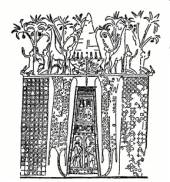
< From the tomb of Huy, viceroy in Nubia during the reign of Pharoah Tut-Anka-Amon
They were also the People of the shem. “The Mesopotamian texts that refer to the inner enclosures of temples, or the heavenly journeys of the gods, or even to instances where mortals ascended to the heavens, employ the Sumerian term mu or its Semitic derivatives shumu (“that which is a mu”), sham, or shem. Because the term also connoted ‘that by which one is remembered,’ the word has come to be taken as meaning ‘name….’ Like most Sumerian syllabic words, mu had a primary meaning; in the case of mu, it was ‘that which rises straight.’ Its thirty-odd nuances encompassed the meanings heights, fire, command, a counted period…”[9]
After Babylonian king Nebuchadnezzar II had rebuilt Marduk’s sacred precinct within fortified walls made of fired brick and gleaming black marble, he recorded: “I raised the head of the boat ID.GE.UL the chariot of Marduk’s princeliness; The boat ZAG.MU.KU, whose approach is observed, the supreme traveler between Heaven and Earth, in the midst of the pavilion I enclosed, screening off its sides.” ID.GE.UL means high to heaven, bright at night. ZAG.MU.KU means bright mu which is for afar.[10] 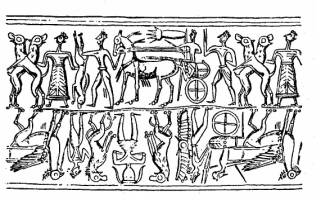
< Sumerian hunting scene awaiting arrival of rocket ship in upper half. Lower half depicts flying chariot shuttle having landed. A god is standing by in the middle.
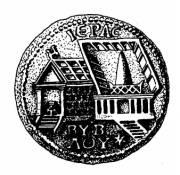
< Coin found at Byblos, ancient Canaanite-Phoenician city on the Mediterranean coast.
The Mesopotamians believed the gods were immortal. The Sumerians said one year on planet Nibiru, a sar, was equivalent in time to 3600 earth years. They also said Anunnaki lifespans were 120 sars which is 120 x 3600 or 432,000 years. According to the King List 120 sars had passed from the time the Anunnakiarrived on Earth to the time of the Flood. However when the Lofty Ones came to Earth their lifespans began to sync with Earth’s faster orbit and they faced rapid aging compared to that on Nibiru. Einstein’s theory of General Relativity says celestial body gravity and motion warps local space/time. They discovered that by eating food from their home planet they could keep the aging process synced to the pace of Nibiru.
The Sumerian god of wisdom Enki (Ea) was the leader of the first sons of Anu that came down to Earth. He played the pivotal role in saving humanity from the global Deluge. He defied the Anunnaki ruling council and told Ziusudra (the Sumerian Noah) how to build a ship on which to save humanity from the killing flood. Ea would have been over 120 sars old at that time, yet his activity with humanity continued to be actively reported for thousands of years thereafter. 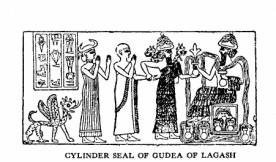
< Ea with gods and initiate. The Water of Life flowing into the laboratory glassware indicates alchemical circulations.
Within his sacred precinct “Mound of Creation” in Eridu, Enki unraveled the secrets of life and death. His emblem was two serpents entwined on a staff — the basis for the winged caduceus symbol used by modern Western medicine. Enki was the god who created the first humans: “In those days, in those years, The Wise One of Eridu, Ea, created him as a model of men.” His name was Adapa, Adam in the Old Testament: “Elohim created the Adam in His image — in the image of Elohim created He him.”[11]
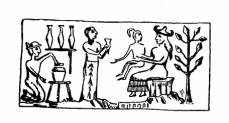
< Creation of first man by Anunnaki. Laboratory vessels and Tree of Life part of scene.
Through Enki’s creative efforts “wide understanding he perfected for him…. wisdom [he had given him]…. To him he had given Knowledge; Eternal Life he had not given him.”[12] Anuwondered “why did Ea, to a worthless human the plan of Heaven disclose — rendering him distinguished, making a shem for him.?”[13] Enki “made him take the road to Heaven, and to Heaven he went up. When he had ascended to Heaven he approached the Gate of Anu.” Enki had told Adapa that if Anu offered him food, he was not to eat the Bread of Life nor drink the Water of Life because they were poison.
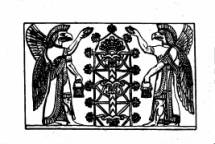
< Angels, Eagles, “bird-men,” picking buds from the Tree of Life with Water of Life flowing within.
After Adapa answered Anu’s questions Anu said, “‘What can we do for him? Fetch him the bread of (eternal) life and let him eat!’
“They fetched him the bread of (eternal) life, but he would not eat. They fetched him the water of (eternal) life, but he would not drink… Anu watched him and laughed at him.
‘Come, Adapa, why didn’t you eat? Why didn’t you drink? Didn’t you want to be immortal? Alas for downtrodden people!’
“‘(But) Ea my lord told me: “You mustn’t eat! You mustn’t drink.”
“‘Take him and send him back to his earth.’”[14]
And so humanity missed out on immortality until the sons of the gods fell in love with the daughters of men, married them and had children by them. Then not wanting their lovers to die they taught them the secrets of immortality that Ea had discovered. Those secrets were the secrets of alchemy. Ea’s youngest son was Ningizzida, Lord of the Tree of Truth, in Mesopotamia. He was revered as Thoth in Egypt and Hermes in the West.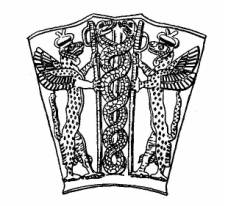
< Emblem of Ningizzida Ea’s youngest son, from King Gudea of Lagash, 2025BCE.
By the beginning of the current era philosophers had removed the physical existence of the gods to the abstract, implying their powers were aspects of spiritual phenomena coincident to the forces of Nature. The early alchemists of that time period still claimed like the ancient priests before them, that the knowledge they possessed was a gift from the gods, and their pursuit of immortality was in emulation of the gods’ pursuit of immortality.
The first maxim of alchemy is “That which is Above is like that which is Below.” If the religious and mythical origins of alchemy represent a portion of the Above, then the anthropological record represents a portion of theBelow. Historian Mircea Eliade wrote extensively about the cultural origins of alchemy. He showed that alchemy was possibly the first offshoot of shamanism and was connected with the origins of agriculture and especially metallurgy. The divine smith was the ancestor of the alchemist.
The shaman/smith highly regarded stones from heaven — meteorites. This celestial metal was sacred. “It was inevitable that meteorites should inspire awe. They came from some remote region high up in the heavens and possessed a sacred quality enjoyed only by things celestial…. They fall to earth charged with celestial sanctity; in a way, they represent heaven. This would suggest why so many meteorites were worshipped or identified with a deity….
“Rock crystals, supposedly broken away from the heavenly throne, do in fact play a special role in the shamanic initiation ceremonies of the Australian aborigines, among the Negritos of Malacca, in North America and elsewhere. These ‘stones of light,’ as they are called by the maritime Dyaks of Sarawak, reflect everything that happens on earth.
“They disclose to the shaman what has taken place in the sick man’s soul and the destination to which his soul takes flight… The shaman is he who ‘sees,’ because he is endowed with a supernatural vision. He sees just as far into space as into time. Likewise he can perceive what is invisible to the layman — spirits, gods, the soul….[15]
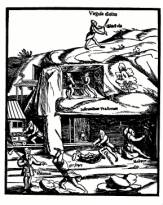
< Divining a mine from Cosmographia Universalis, 1544.
“A mine or an untapped vein is not easily discovered; it is for the gods and divine creatures to reveal where they lie and to teach human beings how to exploit their contents. These beliefs were held in European countries until quite recently. The Greek traveler Nucius Nicander, who had visited Liege in the sixteenth century, brings back the legend of the discovery of the coal mines of northern France and Belgium. An angel had appeared in the guise of a venerable old man and had shown the mouth of a gallery to a smith who had until then fed his furnace with wood…. In other traditions it is also a demigod or a civilizing hero, a divine messenger, who is the originator of mining and metallurgy.[16]
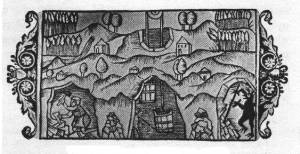
<Demon of a mine from Historia de Gentibus Septentrionalibius, 1555.
“…The sinking of a mine or the construction of a furnace are ritual operations, often of an astonishing primitivism. Mining rites persisted in Europe up to the end of the Middle Ages: every sinking of a new mine was accompanied by religious ceremonies. …One notes the desire to appease the spirits guarding or inhabiting the mine….
“Let us note in passing the animal behaviour of the ore: it is alive, it moves at will, hides, shows sympathy or antipathy to human beings — a conduct not dissimilar from that shown by game towards its hunter.[17]
“There is above all the feeling that one is meddling with the natural order of things ruled by some higher law and intervening in a secret and sacred process. Consequently, every precaution is taken that is considered indispensable to the ‘rites de passage.’ There is the obscure feeling that some mystery is at stake involving human existence, for the discovery of metals has indeed left its mark on man….
“Still charged with this dread holiness the ores are conveyed to the furnace. It is then that the most difficult and hazardous operations begin. The artisan takes the place of the Earth-Mother and it is his task to accelerate and perfect the growth of the ore. The furnaces are, as it were, a new matrix, an artificial uterus where the ore completes its gestation.”[18]
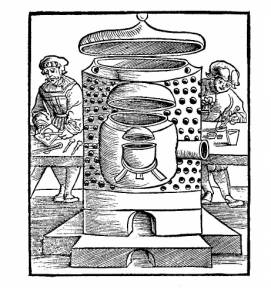
<Alchemical furnace from Geber, de Alchemia, 1529.
In 1925 R. Eisler announced a hypothesis concerning the existence of Babylonian alchemy. This was after the publication of Assyrian chemical texts by R. Campbell Thompson. The tablets were from king Assurbanipal’s great library at Nineveh. Eisler believed these texts were the oldest historical documentation of the idea of the maturation and perfecting of metals, and they constituted proof of the Mesopotamian origins of alchemy. His argument was based on the interpretation of the meaning of term ku-bu in the main text. He believed ku-bu meant embryos, divine embryos. Others translated the term as “a sort of demon,” and an “abortion.” The text says:
“When thou settest out the [ground] plan of a furnace for ‘minerals’ [ku-bu], thou shalt seek out a favorable day in a fortunate month, and thou shalt set out the [ground] plan of the furnace. While they are making the furnace, thou shalt watch [them] and thou shalt work thyself [?] [in the house of the furnace]: thou shalt bring in embryos [born before time]….
“Thou shalt kindle a fire underneath the furnace and thou shalt put the ‘mineral’ into the furnace. The men whom thou shalt bring to be over the furnace shall cleanse themselves and [then] thou shalt set them to be over the furnace.”[19]
In the Babylonian Epic of Creation, (Enuma elish, IV, 136, line 3) “ku-bu designates the monstrous body of Tiamat likened to a foetus, whose demiurge is preparing to shape the world.”[20] The “demiurge” that shapes the world in the Epic of Creation is the god Marduk, the eldest son of Enki.
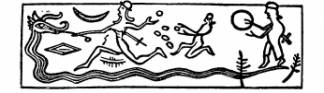 < Marduk fighting Tiamat from Assyrian cylinder seal.“To sum up: in the symbols and rites accompanying metallurgical operations there comes into being the idea of an active collaboration of man and nature, perhaps even the belief that man, by his own work, is capable of superseding the processes of nature.“The act, par excellence, of the cosmogony, starting from a living primal material, was sometimes thought of as a cosmic embryology: the body of Tiamat was, in the hands of Marduk, a foetus. And as all creation and all construction reproduced the cosmogonic model, man, in constructing or creating, imitated the work of the demiurge.“It was an intervention in the process of growth, an attempt to expedite maturation or to induce the expulsion of the embryo.“It was from such ritual experiences, taken in conjunction with metallurgical and agricultural techniques, that gradually there clearly emerged the idea that man can intervene in the cosmic rhythm, that he can anticipate a natural outcome, precipitate a birth… That was the point of departure for the great discovery that man can take upon himself the work of Time, an idea which we have seen clearly expressed in later Western, texts. Here too lies the basis and justification of the alchemical operation, theopus alchymicum, which haunted the philosophic imagination for more than two thousand years: the idea of the transmutation of man and the Cosmos by means of the Philosopher’s Stone. On the mineral level of existence, the Stone was realizing this miracle: it eliminated the interval of time which separated the present condition of an ‘imperfect’ (crude) metal from its final condition (when it would become gold). The Stone achieved transmutation almost instantaneously: it superseded Time.”[21] Zurvan Akarana is the Undifferentiated One from which the two, the Light, and, the Dark, sprang. From them, the manifold arose. The ultimate supremacy of Time was linked with Babylonian astrology. In Zurvan the opposites are contained. The spiritual embodiment for this reconciliation of opposites was embraced by Greek and Indian thought as well.Zurvan embodied the deeper mysteries of the Mithraic initiatic brotherhood. The initiate progressed through seven stages of transformation symbolized by the seven coils of the serpent. Supreme illumination is the last stage where the serpent head is congruent with the third eye of the initiate. Zurvan has four wings on his back representing the flight of the four seasons. He has a fiery thunderbolt on his chest which nothing can resist. This fiery bolt symbol, in exactly the same form is usually attributed to Vajradhara Buddah who Bears the Bolt of Supreme Illumination. Vijrayanna, the Thunderbolt Way is a bold and colorful Tantric Buddhist dicipline. Originally the thunderbolt was the me (power) of Enki (Ea) given to his seven sages.As Zurvan absorbed Hindu initiatic symbolism making it presentable to the West, Time transformed Zurvan into the embodiment of Western eternity: Aion, or Chronos. The seven stages of transformation continued. The seven metals symbolism, also used by the Mithraics, was continued by the Initiates and applied to secret Hermetic Initiatic systems symbolized by Aion and the Zodiac. By the time ofZosimus, Aion had become the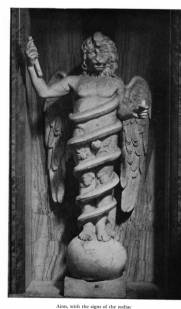
alchemical shaman psychpomp, Ion.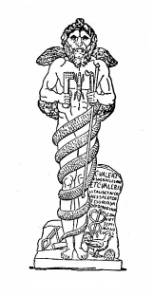
Left: Persian Zurvan Akarana (Boundless Time) from Mithraic marble image, Italy 190 CE.Right: Roman, Aion, from 2nd and 3rd century.
FOOTNOTES
[1]The Book of Enoch, page 487 in THE OTHER BIBLE, ANCIENT ALTERNATIVE SCRIPTURES, Willis Barnstone editor; Harper Collins, New York; 1984.
[2]Idbid, page 489.
[3]THE WARS OF GODS AND MEN, by Zecharia Sitchin; Avon Books, New York, NY, 1985; page 115.
[4]Idbid, page 115.
[5]Idbid, page 117.
[6]THE 12TH PLANET, by Zecharia Stichin; Avon Books, New York, NY; page 169.
[7]THE WARS OF GODS AND MEN; page 196.
[8]THE 12TH PLANET; page 171.
[9]Idbid; page 141.
[10]Idbid; page 140.
[11]Idbid; page 352-353.
[12]Idbid; page 371.
[13]Idbid; page 279.
[14]MYTHS FROM MESOPOTAMIA, CREATION, THE FLOOD, GILGAMESH AND OTHERS, a New Translation by Stephanie Dalley; Oxford University Press, Oxford, NY; 1989; page 178.
[15]THE FORGE AND THE CRUCIBLE, THE ORIGINS AND STRUCTURES OF ALCHEMY, by Mircea Eliade; University of Chicago Press; Chicago, IL; 1962; page, 19.
[16]Idbid; page 53.
[17]Idbid; page 54.
[18]Idbid; page 56-57.
[19]Idbid; page 71.
[20]Idbid; page 74.
[21]Idbid; page 75, 78.