Alchemy Journal Vol.8 No.3

Vol.8 No.3
Winter 2007
CONTENTS
ARTICLES
FEATURES
EDITORIAL
The Planets
Stairway to Heaven
by George L. Beke
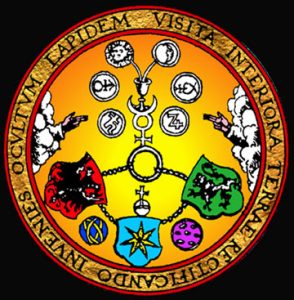
The seven Classical “wanderers” of the sky have a special importance in Alchemy. Each planet is linked to a different metal (Sun to gold, Moon to silver, Saturn to lead, etc.), and the planetary influences were depicted in Basil Valentine’s VITRIOL emblem, which is shown at left.
Where did the esoteric significance of the planets come from? For that, we’d have to go back several thousand years, when the Babylonians and the Assyrians built gigantic stepped ziggurats that led up to the abode of the gods.
By around 700 BC, we find a direct connection between the ziggurats and the planets: “The Khorsabad example preserves clear evidence of a ramp, which spirals up its height, and of some of the different colors with which the different stages were painted: from bottom to top, black, white, orange, blue, red, silver, and gold – each color representing one of the planets or, in the case of silver and gold, the moon and the sun. Seven stages, reflecting these astronomical associations, seem to have been quite typical of later ziggurats, whether found in Assyria or Babylonia.”1
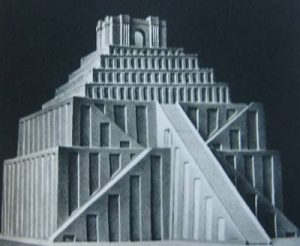
George A. Barton finds such a seven-stepped ziggurat, named the Epa, described on Sumerian-era statues of Gudea of Lagash, more than a thousand years earlier (ca 2100 BC):
“For Ningirsu, his king, Epa, a house of seven stages, to its height he built up.”2
In the cuneiform drum inscriptions of Gudea (ca 2100 BC), we also find the description of such a ‘house of the god’ with seven stages: “Gudea, in charge of building the house, placed on his head the carrying-basket for the house, as if it were a holy crown. He laid the
foundation, set the walls on the ground. He marked out a square,
aligned the bricks with a string. He marked out a second square on the site of the temple, saying, “It is the line-mark for a topped-off jar of 1 ban capacity (?).” He marked out a third square on the site of the temple, saying, “It is the Anzud bird enveloping its fledgling with its wings.” He marked out a fourth square on the site of the temple, saying, “It is a panther embracing a fierce lion.” He marked out a fifth square on the site of the temple, saying, “It is the blue sky in all its splendour. “He marked out a sixth square on the site of the temple, saying, “It is the day of supply, full of luxuriance.” He marked out a seventh square on the site of the temple, saying, “It is the E-ninnu bathing the Land with moonlight at dawn.”3
Gudea’s god appears to him in a dream, and instructs him as to the form that the temple should take:
“Ningirsu stepped up to the head of the sleeper, briefly touching him: “You who are going to build it for me, ruler, you who are going to build my house for me, Gudea, let me tell you the ominous sign for building my house, let me tell you the pure stars of heaven indicating my regulations…” ”4
Gudea’s temple has seven stages, and most importantly, it’s marked out according to the regulations of the “pure stars of heaven.” It would be difficult to escape the conclusion that the ziggurats of Mesopotamia represented a ‘stairway to heaven,’ and an ascent through the planets to the abode of the gods.
Around 185 AD, the Greek philosopher Celsus wrote about Mithraic beliefs “in the old Persian mysteries associated with the cult of Mithras. In that system, there is an orbit for the fixed stars, another for the planets and a diagram for the passage of the soul through the latter. They picture this as a ladder with seven gates, and at the very top an eighth gate: the first gate is lead, the second tin, the third bronze, the fourth iron, the fifth an alloy, the sixth silver, and the seventh gold.”5
The correspondences here, between planets and metals, are similar to the scheme that would later be held by Alchemists, while the planetary ladder echoes the ascent on the stairs of the Mesopotamian ziggurats.
Similar celestial stairways and ladders are found, thousands of years earlier, in the Egyptian Pyramid Texts (ca 2300 BC) and later Coffin Texts: “A stairway to the sky is set up for me that I may ascend on it to the sky…”6 “I have joined my mother the Great Wild Cow… and I ascend on this ladder which my father Re made for me…”7 “O Lord of Flame guarding the doors of the sky, open the doors of the sky, put the ladder together for me, make a way for me…”8
The Greek philosopher Pythagoras is said to have spent years in Egypt and Mesopotamia, and when he returned to Greek territories, he opened a school in Croton, southern Italy, around 520 BC. One of the cryptic Sayings (Akousmata) of the Pythagoreans goes: “What is the oracle at Delphi?” “The Tetraktys, the very thing which is the Harmony of the Sirens.”9
Pythagoreans swore their oaths on the Tetraktys, a triangular design with one dot at the top, two dots below it, three dots below that, and four dots at the bottom. This arrangement reflects the harmonic concepts at the heart of Pythagorean thought, embodying the musical ratios of the intervals of the Octave (1:2), the Fifth (2:3), and the Fourth (3:4). The Harmony of the Sirens is the music of the planetary spheres, as Plato explains in his Republic (ca 360 BC): “The whole spindle is turned in a circle with the same motion, but within the revolving whole the seven inner circles revolve gently in the opposite direction… Above, on each of its circles, is perched a Siren, accompanying its revolution, uttering a single sound, one note; from all eight is produced the accord of a single harmony.”10
The Pythagorean construct of the Music of the Spheres would rule Western thinking for two thousand years. The Roman orator Cicero (ca 40 BC) modeled his De Republica on Plato’s text, and in the end part called the ‘Dream of Scipio,’ he too describes the Harmony of the planetary Spheres: “What is this sound, so loud and yet so sweet, that fills my ears?” “That is the sound produced by the impetus and momentum of the spheres themselves… Those eight rotating spheres (of which two, being an octave apart, produce the same effect) give out seven distinctive sounds according to their intervals. That number is more or less the linchpin of everything.”11
The number Seven was already seen as having special significance in Egypt and Mesopotamia, but with the Greeks we find a connection between the seven Planets, the seven notes of the musical octave, and the seven vowels of the Greek alphabet.12
During the early Christian era (ca 100 AD), the Gnostics combined the attribution of the seven Greek vowels to the planets with a celestial ascent.13 In the Gnostic ‘Wings’ prayer, which carries one up the planetary ladder, the vowels are chanted forward and backward, dropping one vowel after each repetition. We start at Alpha and arrive at Omega, the highest planetary sphere:
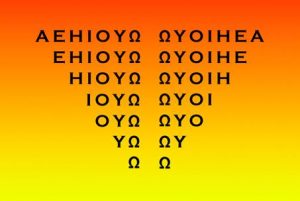
This echoes John of Patmos’ Book of Revelation: “I am the Alpha and the Omega.” But we should keep in mind that there’s no indication that Jesus spoke Greek, and therefore those words show a strong Hellenistic influence on the Book of Revelation.
Martianus Capella, a late Roman writer in Carthage (ca 415 AD), paints an allegorical celestial ascent, similar to that of the Gnostics, through the planets using musical intervals: “After this, by half of the tone by which she got to the Moon she came to the circle of the Cyllenian [Mercury]… Philology ascended rapidly from here and flew by a half tone as far as the circle of Venus… Soon she was eager to make the laborious journey to the Sun’s circle – an ascent rendered toilsome by its distance of three half tones, or a tone and a half.”14
Martianus goes on to describe the seven Liberal Arts, laying the foundation of Medieval university education, and by extension, the basis of today’s higher education.
The Pythagorean numerical system15 found a later expression in the Kabbalah, which became intimately linked with Alchemy. The Kabbalistic Tree of Life contains a celestial ascent through the planets, much as we saw in Gnosticism, in Mithraism, in the Mesopotamian ziggurats, etc. As Rabbi Aryeh Kaplan writes:
“The seven vertical paths associated with the seven Doubles [Hebrew letters] are manifest in the physical world as the astrological forces associated with the seven planets: Saturn, Jupiter, Mars, Sun, Venus, Mercury and Moon… These letters are therefore the ladders leading upward from the seven lower Sefirot… One of the main functions of the seven Doubles is thus to climb vertically on the ladder of the Sefirot. One rises through their hard sound, and descends with their soft sound.”16
In the Paradiso (ca 1310), the Italian writer Dante also tells of a heavenly ascent through the planets, though in a Christianized form. “Having climbed the mountain of Purgatory, Dante begins to ascend the heights of the universe with his beloved Beatrice as guide. They soar through the nine spheres of heaven – the moon, Mercury, Venus, the sun, Mars, Jupiter, Saturn, the stars and the Primum Mobile.”17
In his text, Dante mentions Plato (pointing to his source), and describes the Music of the Spheres:
“So, at that orizon devout and prompt,
“The holy circles a new joy displayed
“In their revolving and their wondrous song.”
 The German mathematician Johannes Kepler used the Pythagorean Harmony of the Spheres, as inspiration, to arrive at his Third Law of Planetary Motion in his Harmonice Mundi, which Stephen Hawking chose as one of the most important scientific texts.18
Kepler’s Laws of Planetary Motion led to our current Space Age (as they are still used today to calculate celestial orbits), and therefore we can thank the Pythagoreans, who were seen as direct ancestors by the Alchemists, for the monumental progress in the physical sciences today.
The monotheistic religions sought to eradicate any pagan veneration of the Planets, yet they each encoded the ancient planetary knowledge in ways that are not readily apparent to their followers. The Jewish historian Josephus wrote that the great Menorah in the Jerusalem Temple, with its seven branches (as shown on the Arch of Titus in Rome), represented the seven Planets.19
 The Jewish philosopher Philo of Alexandria makes the same connection while attempting to reconcile Jewish and Hellenistic thought, and he alludes to the Music of the Spheres: “The candlestick he placed at the south, figuring thereby the movements of the luminaries above; for the sun and the moon and the others run their courses in the south far away from the north. And therefore six branches, three on each side, issue from the central candlestick, bringing up the number to seven, and on all these are set seven lamps and candle-bearers, symbols of what the men of science call the planets. For the sun, like the candlestick, has the fourth place in the middle of the six and gives light to the three above and the three below it, so tuning to harmony an instrument of music truly divine.”20
In the New Testament, John of Patmos, author of the Book of Revelation, is obviously following this planetary tradition: “Write the things which thou hast seen, and the things which are, and the things which shall be hereafter; The mystery of the seven stars which thou sawest in my right hand, and the seven golden candlesticks.”
And when Muslim pilgrims arrive at Mecca, their first duty is to circumambulate the Ka’aba, the central shrine of all Islam. The first three circumambulations are to be done at a fast clip (like the quick orbits of the three inner Planets), while the remaining four circuits can be done at a more leisurely pace (like the slower orbits of the outer Planets).
The seven pagan Planets are still with us in our secular world, for the days of our Week are named after them, and the Music of the Spheres is encoded in our week, as Cassius Dio explains: “The custom of referring the days to the seven stars called planets was instituted by the Egyptians, but is now found among all mankind… If you apply the so-called “principle of the tetrachord” (which is believed to constitute the basis of music) to these stars, by which the whole universe of heaven is divided into regular intervals, in the order in which each of them revolves, and beginning at the outer orbit assigned to Saturn, then omitting the next two name the lord of the fourth, and after this passing over two others reach the seventh, and you then go back and repeat the process with the orbits and their presiding divinities in this same manner, assigning them to the several days, you will find all the days to be in a kind of musical connection with the arrangement of the heavens.”21
Perhaps practicing Pythagorean dissemblance, Dio describes a musical scheme which is not incorrect, but which gives a misleading descending order from the highest planet, Saturn, according to the weaker musical interval of the Fourth (skipping two notes or planets).
The more correct, stronger musical interval would be that of the Fifth (skipping three notes or planets), which gives an ascending, complementary order starting from the Moon, going to Mars, to Mercury, to Jupiter, to Venus, to Saturn, and then to the Sun, the star at the very heart of our planetary system.
In sum, the order of the days of our Week encodes a Pythagorean harmonic ascension, a tradition steeped in the planetary stairways of Mesopotamian ziggurats, and echoed in the beliefs of the Mithraists, of the Gnostics, and of the Neoplatonists, who saw the Planets as a lyrical “stairway to heaven.”
Next time you wake up on Monday (Moonday) morning, consider if you will the Odyssey through the Planets that’s been planned out for you thousands of years ago, for the next seven days, to the furthest reaches of the stellar firmament.
REFERENCES
1. The Oxford Encyclopedia of Archaeology in the Near East, edited by Eric M. Meyers (American Schools of Oriental Research, 1996).
2. The Form and Nature of E-Pa at Lagash, by George A. Barton, Journal of the American Oriental Society, Vol. 43 (1923), pp 92-95.
3. The Electronic Text Corpus of Sumerian Literature, (Gudea, cylinders A and B): c.2.1.7
4. The Literature of Ancient Sumer, by Jeremy Black, Graham Cunningham, Eleanor Robson, and Gabor Zolyomi (Oxford University Press, 2004), p. 49–50.
5. Celsus, On the True Doctrine – A Discourse Against the Christians, translated by R. Joseph Hoffmann (Oxford University Press, 1987), p. 95.
6. The Ancient Egyptian Pyramid Texts, R.O. Faulkner (Clarendon Press, 1969), p. 76.
7. The Ancient Egyptian Pyramid Texts, p. 79
8. The Ancient Egyptian Coffin Texts (Vol. 1), R.O. Faulkner (Aris & Phillips, 1973), p. 78.
9. The Pythagorean Sourcebook and Library, Kenneth Sylvan Guthrie (Phanes Press, 1988), p. 77.
10. The Republic of Plato, translated by Allan Bloom (Basic Books, 1968), p. 300.
11. Cicero, The Republic, translated by Niall Rudd (Oxford University Press, 1998), p.90.
12. The Mystery of the Seven Vowels: In Theory and Practice, Joscelyn Godwin (Phanes Press, 1991).
13. The Greek Magical Papyri in Translation, by Hans Dieter Betz (Univ. of Chicago Press, 1997), p. 323, PGM CXXX.
14. Martianus Capella and the Seven Liberal Arts: Volume II; The Marriage of Philology and Mercury, by William Harris Stahl (1992)
15. The Theology of Arithmetic, Attributed to Iamblichus, translated by Robin Waterfield (Phanes Press, 1988).
16. Sefer Yetzirah – The Book of Creation, In Theory and Practice, by Aryeh Kaplan (Samuel Weiser, 1997), p. 165-166.
17. Dante Alighieri, The Paradiso, translated by Henry Wadsworth Longfellow (Barnes & Noble Classics, 2006), blurb on back cover.
18. Stephen Hawking, On The Shoulders of Giants, (Running Press Book Publishers, 2002), p. 670.
19. Josephus, Antiquities III, 183.
20. Philo, Volume VI, “On Moses,” (Loeb Classical Library, Harvard University Press, 2002), p. 499.
21. Dio Cassius, Roman History (Books 36 – 40), translated by Earnest Cary (Harvard University Press, 2001), pp 129 – 131.
© 2007 by George L. Beke
Where did the esoteric significance of the planets come from? For that, we’d have to go back several thousand years, when the Babylonians and the Assyrians built gigantic stepped ziggurats that led up to the abode of the gods.
This is of course, the bare skeleton of a hypothesis. More research will be needed to flesh it out, and then extensive testing in the lab and even more research of the history will be needed to produce a historical model and chemical theory as to how this chemical was produced four centuries ago
 Alchemical Fire in a Glass: A Primer
By Jack Lantern
This is the excerpt of an alchemical tract which began my search for a hypothesis of the actual chemical formula and the ancient alchemist’s method of creating the chemical. The following quote is from John French, The Art of Distillation, London 1651. (Retrieved from www.alchemywebsite.com/alchfire.html – Adam McLean 2007.)
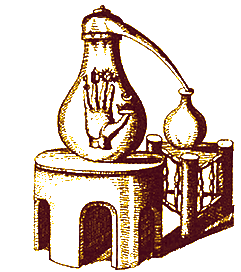
“To keep fire in a glasse, that whilest the glasse is shut will not burne, but as soone as it opened will be inflamed. First extract the burning spirit of the salt of tin in a glasse Retort well coated; when the Retort is cold, take it out and break it, and as soone as the matter in it, which remains in the bottome thereof after distillation, comes into the aire, it will presently be inflamed. Put this matter into a glasse viall, and keep it close stopt. This fire will keep many thousand yeares and not burne unless the glasse be opened: but at what time soever that is opened it will burne. It is conceived that such a kind of fire as this was found in vaults when they were opened, which many conceived to be a perpetuall burning Lamp, when as indeed it was inflamed at the opening of the vault, and the letting in aire thereby which before it lacked, and therefore could not burne. For it is to be conceived that there is no fire burnes longer than its matter endures, and there is no combustible matter can endure for ever. There may be many uses of such a fire as this, for any man may carry it about with him and let it burne on a sudden when he hath any occasion for fire.”
Of course the first step was to find a Salt of Tin that fit the description of the reaction taking place, a chemical which burns when exposed to air. I found out that only one salt of tin combusts in air, stannous bromide, or tin (II) bromide. The chemical being identified, I moved on to trying to figure out how an alchemist in the 17th century would have been able to manufacture the chemical.
My first investigation along these lines was to find out how such a chemical could be synthesized without exposing it to air. The excerpt makes reference to keeping the salt well stopped, but before that makes absurd suggestions of how the material should be handled. They are absurd because it does not take into account the behavior of the substance when in the presence of oxygen. It is known that alchemists often would intentionally obscure their own writings, to keep the inexperienced from stealing their knowledge. This led to the question of how an alchemist would distill stannous bromide without exposing it to air. A stoppered container heated would explode and a distillate exposed to air would burn.
When any solution is heated in a container, several things happen. As the air in the container is heated, it escapes from the container to maintain equal air pressure with the air outside of the container. Also, as the solution is being heated, its vapor pressure begins to equalize with the atmosphere inside and outside of the container, it does this by expelling air from the container. As air is heated, its pressure rises, and since the volume of the container is fixed, air must be expelled from the container. When a liquid vapor pressure equals the pressure of the surrounding atmosphere, it begins to boil. This is important. It is not hard to imagine that with constant work spent on heating substances, that eventually one of the alchemists would have stumbled on a phenomena involved with vapor pressure. If a container filled with an amount of solution is stoppered and rapidly cooled with an ice bath, two things will happen. The air pressure within the container will fall, and as the temperature falls, so does the pressure. The liquid, still containing much of the energy from the heating, will not cool as quickly, and so, because the solutions vapor pressure is still very high, and the air pressure in the container is very low, the liquid would boil. So the alchemist would boil the solution until it was just about to sputter, pop, and the solute would be exposed to air. Then the alchemist would stopper the container, and place the container in an ice bath. For a day I was stumped with how an alchemist would be able to produce and ice bath without a freezer. Then it hit me. In the 17th century Europe was still in the grip of the “Mini-Ice Age”; so, for at least one fourth of the year, there would have been a ready supply of snow and ice in just about any spot in Europe you would care to look.
Having solved the problem of this part of the synthesis of the chemical, my efforts turned toward finding the source of tin and bromine used in this operation, which has proved to be the most difficult part of the construction of this hypothesis. Elemental tin is found from many sources. The most attractive to the medieval alchemist, due to the peculiarity of their discipline, would have been a plant source. This is because it fit their view of the world, in which plants, minerals and animals had an inner essence, which could be distilled and transmuted from plant to mineral, mineral to plant, and all other combinations possible between those three. A plant very common in Europe, which contains 67 ppm of elemental tin, is the plant Elymus repens, commonly known as couchgrass. This plant is considered a weed, so it would have been readily available in large amounts, crucial because the amount needed to produce a sizable amount of tin would have been immense.
The issue of the bromine is probably the most troublesome. Bromine was not discovered as an element and a pure substance until 1860, by Antoine Ballard in the salt marshes of Montpellier. Bromine can be recovered from brine wells and the Dead Sea which has a concentration of approximately 5000 ppm. Evidence that anyone in Europe knew this however, is currently non-existent.
This is of course, the bare skeleton of a hypothesis. More research will be needed to flesh it out, and then extensive testing in the lab and even more research of the history will be needed to produce a historical model and chemical theory as to how this chemical was produced four centuries ago.
__________________________
Jack Lantern is currently pursuing a bachelor of science in chemistry at San Jose State University. When his time is not occupied with learning chemistry, Jack studies the history of chemistry, alchemy, sorcery and the occult. “If I told you what organization I am a priest in”, Jack says, “it would spoil the fun”. Jack can be contacted at: [email protected]
Like the mystic opening up “to an influx from a realm beyond the mundane level of the human mind”, the true Hermetic or Mercurial poet enters a ‘prophetic state’ of visualisation – enabled by the ‘wakeful’ heart – “through which the imagination connects our minds with the sphere of divine influence.” My poems are testament to this state of being, and the power of the Green Language “to delude, elucidate and condense.”
 By the Graciousness of the Veil: Four Poems
By Paul Hardacre
“The purpose of the Green Language … is to disguise ideas … so that they will be evident only to those familiar with the tongue, yet offer a semblance of a meaning to those who cannot read the language.”
So says the acclaimed author David Ovason in his radical 1997 interpretation of the prophecies of Michel de Nostredame, The Secrets of Nostradamus, with reference to the use of the aviantongue by the legendary French apothecary and mystic in his “obscure” and “crabbed” quatrains. However, the seer of Saint-Rémy-de-Provence was by no means alone in his employ of this brilliant technique (or collection of techniques) of linguistic obfuscation.
Since ancient times, diverse authors – including the Persian poet Farid ud-Din Attar, with his Manteq at-Tair (The Conference of the Birds); François Rabelais (who originally published works under the anagrammatic pseudonym Alcofribas Nasier, for fear of being labeled a heretic) with the now universally acknowledged books of Renaissance romp and ribaldry of the two giants, Gargantua and Pantagruel; and the satirical fabulist Jonathan Swift, whose Gulliver voyaged to ‘Parts Unknown’ and the imaginal lands of Lilliput, Brobdingnag, Laputa, Balnibarbi, Luggnagg, and Grubbdubdrib – have toiled to veil the intentions, or the esoteric meaning, of their words from a general reader, in favour of a specialist or ‘initiated’ reader capable of decoding or unveiling the true meaning, embedded within the black and white fires of a given text.
The canonical and revered works of il Sommo Poeta, Dante Alighieri; Mozart and Schikaneder’s The Magic Flute; the masterpieces of the Florentine school by Alessandro di Mariano di Vanni Filipepi (also known as Sandro Botticelli); the argot (Art Gotique – not to be confused with Jason’s ship, the Argo, the oaken figurehead of which, carved from a tree of the sacred grove of Dodona, could speak the Language of the Birds) of that most enigmatic Adept of Hermetic Science, Fulcanelli; the timeless songs and sagas of peoples Egyptian, Greek, Roman, Norse, Celtic, Welsh, German, Russian, and more; the countless alchemical and other occult texts, from the age of the red hermaphrodite onwards, the time of Thoth-Adam, and understood by personages including – but by no means limited to – Zosimus, Moses, Solomon, Anaximander, Tiresias, King Dag the Wise of Sweden, and Francis of Assisi … these are works of the wise, by initiates drunk on the divinity of words, the good red wine of Bacchus. God-intoxicated lovers of the Language of Angels, masters of the medu-netjer (‘divine language’), custodians of the closed language, troubadours of the hidden tongue, and guardians of the Gay Speech alike have preserved the truths of the philosophia perennis.
In 1945 the English writer and thinker Aldous Huxley summarized the perennial philosophy, in the book of the same name, as:
“… the metaphysic that recognises a divine Reality substantial to the world of things and lives and minds; the psychology that finds in the soul something similar to, or even identical with, divine Reality; the ethic that places man’s final end in the knowledge of the immanent and transcendent Ground of all being; the thing is immemorial and universal.”
Importantly, in the context of our subject, he continues:
“Rudiments of the perennial philosophy may be found among the traditional lore of primitive peoples in every region of the world, and in its fully developed forms it has a place in every one of the higher religions.”
As Huxley asserts, one need look no further than the great Holy Books, among them The Sepher Yetsirah, Genesis, and The Song of Songs which is Solomon’s, and other books of the Old and New Testaments – along with their contemporary cabalistic analyses by the likes of the French writer, painter and qabalist, Carlos Suarès and the Belgian-born alchemist Artofferus – to experience some of the most sublime celebrations of the language which, according to the Master Alchemist in Le Mystère des Cathedrales, “ … teaches the mystery of things and unveils the most hidden truths.” Such texts are deserved treasures and wondrous symbols and, as Manfred Lurker, quoting Goethe, in 1987’s Wörterbuch der Symbolik, emphasizes, “The symbol is at once concealment and revelation”; it is Ovason’s “double science, sacred and profane.” And so it is that we come to know, as Brian L. Lancaster states in The Essence of Kabbalah, that “the whole of life conforms to this pattern: we are confronted with a veil that paradoxically both conceals and reveals the true nature of reality. The mystic is the person who studies and practices in order to grasp that which lies beyond the veil.”
Similarly, poets and alchemists – along with those increasingly rare poet-alchemists – are, in the words of A.E. Waite, interpreters of “the unrealisable beauty of that which is behind the veil,” doing so ‘by the graciousness of the veil.” The poems of liber xix: differentia liber are the products of a heart which is ‘awake’; of a ‘supersensual researcher’ who has benefited from Ezekiel’s gift – Ezekiel having transmuted my “heart of stone” into a “heart of flesh”; this process being, according to Lancaster, arguably the most vital obstacle to be overcome “in order that the heart may achieve its proper spiritual function, that is, as an organ of prophecy.”
Like the mystic opening up “to an influx from a realm beyond the mundane level of the human mind”, the true Hermetic or Mercurial poet enters a ‘prophetic state’ of visualization – enabled by the ‘wakeful’ heart – “through which the imagination connects our minds with the sphere of divine influence.” My poems are testament to this state of being, and the power of the Green Language “to delude, elucidate and condense.”
____________________
as black, as dark
“An eternal dream, full of the sweetest surfeit of life – restless –
with fearful pains inside, in the soul.”
– Egon Schiele
“Out of fear of her fire burns; out of fear the sun shines.”
– Katha Upanisad 2.3.3
under world or walls her giving hand &
clad in space she flowers woods & wound
with ‘curling growths’ the skulls that carried
life or left behind in tree or drain / collected
teeth or nails the town its tawny bronze-dark
music (dead) outside the hills & sea beyond
the heart / to dance or lose the way to laugh
in tunnels fog or eyes or veiled by pain & free
like marigolds or tea her dusty train imagined
snow & skin all white as age or hell / her milk
a complex fashion from the north & born of fire
(or pictures of fire / the five-wicked pop of ants &
sound of bells) the uncooked food & fruits she lifts
marmotic futures higher than people grass or star –
a desolation skin of curves her diadem of bones to
have or draw some kind of silver horn or minaret in
red a devil (maybe french it’s monday made from heads
a plate of doves & sugar / water ghosts the river wears a
tongue & round the hips her peeling ichor birds & bloom
born from his dead father’s arm
“The trees are speaking on the far shore
we’ll never get there in time…”
– Robert Adamson, Black Water
“Like the swan which drinks milk only from milk-water
so should the substance of the world be drunk.”
– Kanhupada, Raga Indratala
go-round swings he hangs the orange
sky collides with shadows / people
haunt the thinning trees the punctured
eye & hair like lightning dust or bubbles /
years (abandoned houses stars she gives
her beaming light & tongue & vital airs
eclipse his head a light or vapour finds
her powdered breasts her lotus sword &
studied skull a southern-fire (delight or
wishing cow) & rubbed by sages in the
night his faces unclean peel a blackened
may: white-flock carpet heart & rain –
‘the fine grey nature’ of earth in mouth a
moonbeam’s grubby thread she sinks in
rags & callow youngsters folded back his
arms (the gallows bird the upward moving
other self he steals & rides a mouse through
time his face a rusty frying-pan or pearly tusk
& hatched the waters gold / the peacock sky
forbidden kiss
“Love is the law, love under will.”
– The priest of the princes, Ankh-f-n-khonsu
“This being-of-darkness spreads everywhere like unconscious sleep,
shapeless, ineffable, undefinable.”
– Manu Smrti 1.5
of person & nature he cradles her tit
& sounds like jaws upstairs in place of
feet or knobs of bone his nerve-wrack
sinews / seeds in pods or cold time iron
box her monster lump of quickness stone
& secret dresses (untouched, headless
gift of unseen rivers plants & rags her
breasts adorned with lotus jewelled with
teeth & horns a pair of wings a siam path
to sunlight edge of sea she calls the waves
to bathe or love to baphomet ‘all curious
looking’ covered in sores & balls like nandi
(fine & shiny mangled boobs & skulls / this
beast a hollow head with bag of bile he slips &
falls is dark & wants to bite her lips her thumb
like early gleeson / bloody tubes & sperm all made
of bricks & upside down in spring he dangles /
worms that end in mouths that end in crushing births
or 666 (caves with hermits, sex before used shadows
storm bones, sea
“Sleep is an unripe fruit of death. A dream is an unripe
fruit of prophecy. The globe of the sun is an unripe fruit
of the supernal light.”
– Bereshit Rabbah 17:5
“Go round the world and roar like a lion!”
– Sage Yogaswami (to Satguru Sivaya Subramuniyaswami)
whitesnake hair he sits in one more
sun & furs all black into the hills his cave
& to the sea the guest of men takes rice &
curds he speeds & is perfected as a corpse
concealing grace or into sparks to splinter
days & rise his ancient thread-thin ray of love
he drives a donkey timbrels flutes & harps a
road a sky-gauge span & messengers of winds
of man is old or is a serpent close to sunset
stands his mouth as earth or white & ruddy
tree & joined to days like flame to burning
coal to blue-green beryl eyes he bakes on
stones as light all dark from shining black &
summer opened blue to rise like cakes of oil
& wheat he kissed of oil & words of (don’t
look!) chaos: quickening / his sandal waters
leavings of his food & no place empty of it –
help for dead or thin like slice of ruby egg he
follows bones of storms & poisons morning
_____________________
Paul Hardacre is a poet, editor, publisher, and aspirant to the Stone born in Brisbane, Australia in 1974. He is the Managing Director of two independent presses: boutique arts publishers, papertiger media (since 2000), and esoteric, occult and arcane book publishers, Salamander and Sons (since 2007). He is the author of two poetry collections: The Year Nothing (HeadworX, Wellington, 2003) and Love in the place of rats (Transit Lounge, Melbourne, 2007). With his long-time partner, artist and graphic designer Marissa Newell, he currently divides his time between Brisbane and Chiang Mai, Thailand. papertiger media: www.papertigermedia.com / Salamander and Sons: www.salamanderandsons.com
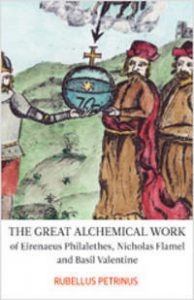
Taking as his starting point the classic works of three well-known Adepts – Eirenaeus Philalethes, Nicholas Flamel and Basil Valentine – Rubellus offers aspirants a clear explanation of these highly cryptic, often deliberately misleading, texts
 FEATURES
New Releases
The Great Alchemical Work of Eirenaeus Philalethes, Nicholas Flamel and Basil Valentine
by Rubellus Petrinus
< To Order this book online, click on bookcover.
Quality Paperback. Illustrated with Glossary and Bibliography. Salamandar and Sons, 2007. $22.95
The Great Alchemical Work is an important contribution to the study of alchemy. In the first English language edition of this ‘little work,’ Portuguese alchemist Rubellus Petrinus presents a sincere and invaluable guide to the operative laboratory tradition that gave birth to the Art of Hermes and its vast literature. Taking as his starting point the classic works of three well-known Adepts – Eirenaeus Philalethes, Nicholas Flamel and Basil Valentine – Rubellus offers aspirants a clear explanation of these highly cryptic, often deliberately misleading, texts.
According to Frater Parush (A.H.S.), in his preface, “… the interested student will find herein one of the best publications now available of the accurate and proper understanding of some important pieces of classic alchemical cypher. Rubellus removes a good portion of the veil from over the works of Flamel, Valentine and Philalethes concerning the Great Work, and thereby opens the door to a wider understanding of other related literature.” Drawing upon his more than thirty years of discipline and experience, Rubellus generously shares his knowledge that has had “all that is superficial removed from it,” and daringly exposes the facts of the secret processes of the Art. The Great Alchemical Work features full colour plates with photographs of alchemical processes, products and equipment, along with rare reproductions of early woodcut versions of Basil Valentine’s famous Keys.
Rubellus Petrinus was born in Bragança, Portugal, in March 1931. As a young man, he traveled to Angola where he worked in telecommunications and pursued his hobby as a ham radio operator. After reading Le Matin des Magiciens by Louis Pauwels and Jacques Bergier, he became determined to experience and understand alchemy. Although far removed from the hub of European alchemical activity, he continued his studies by reading the works of Fulcanelli. As Angola moved towards independence, he returned to Portugal and settled in Queluz, near Lisbon. For the next three decades he continued his pursuit of the Great Work, studying operative alchemy in France, Spain and his native country with the Master Solazaref, Simón H. and Roger Caro. Having made substantial progress on numerous paths – including the Dry Way, the Wet Way and the way of Kamala Jnana – he continues towards the realisation of the Philosopher’s Stone, and the fulfillment of a lifetime of study and practice.
Announcements
- The work of alchemist Roger Caro is available in English translation and 40 photos from his lab work are now posted athttp://www.rexresearch.com/caro/caro.htm .
- Alchemist Arion Love has notified us that a free movie on the growing threat of corporate control is now available. Click here to view. The movie is called “Endgame: Blueprint for Global Enslavement and the website is at http://www.endgamethemovie.com .
- Jeff McBride sent this video link of the transformations of the Moebius. There is a Hermetic component here too. It shows so wonderfully how the infinite forms of the Moebius originate in the One, which mathematically is the sphere which projects as a circle. Just like our reality. As Above, so Below. Go to http://www.youtube.com/watch?v=JX3VmDgiFnY&NR=1 .
- In September 2007. John Reid’s Golden Vessels was spun off to become its own entity, and the new company name is Golden Vessels Corp. Spagyria, Inc. will continue to function as an educational center for alchemy. Please go to www.spagyria.com for more information. You can now buy complete sets of Essentia Magazines for $150 and Gently for $65. Those persons who have previously ordered these items at full price will receive a refund for half their original purchase price. For more information go tohttp://www.spagyria.com/specials/FraterAlbertusLegacyPublications.asp .
- Writers Wanted! The Alchemy Journal is always looking for articles on any aspect of alchemy, including biographies, historical material, practical laboratory work, spagyric recipes, philosophical pieces, poetry, experiences in personal transformation, spiritual insights, Hermeticism, Gnosticism, book reviews, film and video reviews, website reviews, artwork, etc. Please submit your material or queries via email to our editor at [email protected].
Send your announcements to the Alchemy Journal.
Lectures & Conferences
February 8-10, 2008. MYSTERIUM CONFERENCE in Las Vegas, Nevada
Mysterium, a conference on the royal art of Alchemy, will be presented in three days of ritual, music, magic and mystery in Las Vegas in February. Mysterium is an alchemical fusion of art, ritual theater, shape-shifting, trance-dance, ceremonial magick, spoken word poetry, invocation, meditation, divination, rites of purification, transformation, illumination and celebration! The event features:
- Community Feast: Nourish your body, mind and spirit as you reconnect with old friends, and meet new friends!
- CandleDance: A techno-tribal dance extravaganza, featuring live DJs and performance art, hosted by ArchMage Jeff McBride!
- Exciting new workshops: Grow your mind, flex your body and let your spirit soar with ours!
- DreamCircle Alchemy: Creating sacred space to explore and empower our dreams and bring them to life!
- Mysterium Ritual Theater: All night, indoor, sacred fire circle, with drumming, dancing, spoken word, chanting and spontaneous ritual offerings!
Due to space limitations, registration is limited to the first one hundred participants. Registration for the entire weekend, is only $75, which includes all events, workshops, and meals (Potluck Feast, Breakfast on Sat and Sun, Potluck dinner Sun. night) Limited work trade is available for those in need. Call Spinner at 702-450-0021 to discuss the possibilities.
July 7-10, 2008. MEDIEVAL CONGRESS in Leeds, England.
For next summer’s International Medieval Congress at Leeds (7.-10. July 2008), an already accepted session on “Alchemy and the Larger World” could now use a third 20-minute, scholarly paper on any aspect of alchemy in a broader cultural or societal context. Proposals should be submitted via the Congress’ online Paper Proposal Form, available at:http://imc.leeds.ac.uk/imcapp/Submit/PaperProposalForm.jsp . Abstracts should be headed by a note indicating that this is for Session 2429 (Alchemy and the Larger World). Proposals arriving within the next two weeks will receive first consideration. General information about the Congress is available at its website: http://www.leeds.ac.uk/ims/imc/index.html
October 10-12, 2008. INTERNATIONAL ALCHEMY CONFERENCE in Las Vegas, Nevada.
The second International Alchemy Guild (IAG) is currently organizing what looks to be another powerful gathering of alchemists and alchemical practitioners. The goal is to represent all aspects of alchemy, including the practical and spiritual paths, East and West, and modern perspectives such as transpersonal psychology. The event is scheduled to take place over the Columbus Day weekend in Las Vegas. Deep discounts are offered now for early registration. Complete information is at www.AlchemyConference.com .
For a complete listing of other current lectures and workshops on alchemical topics, please go towww.AlchemyConference.com/lectures.htm .
FEEDBACK
An Alchemical Perspective of the Hunchback of Notre Dame
Recently, I have been studying Dr. Dennis William Hauck’s book, “The Sorcerers’ Stone” (which is the companion to Hauck’s “The Emerald Tablet”). In this book the author makes (p.100) an excellent alchemical study of the film “2001 – A Space Odyssey” by director Stanley Kubrick. This reading awakened my sensitivity for other works whose alchemical message might be hidden as well. So ”it happened” that the week just before flying to Las Vegas, Nevada for an Alchemy Conference (Oct. 2007) organized by the same Dr. Hauck, I watched on TV the old film “The Hunchback of Notre Dame” (1939), directed by William Dieterle and starring, among others, Charles Laughton and Maureen O’Hara. (I discovered later that this is a “talking” cinematographic version of Victor Hugo’s novel, “Notre Dame de Paris” published in 1831. Victor Hugo was a successful occultist in his time, and claimed as a member by the Rosicrucian Order and the Masons.)
The film revisited the case of the beauty and the beast. As the story goes, in the beginning it is the beast Quasimodo (Charles Laughton), who possessed of a strange admiration of the beauty of the gypsy girl Esmeralda (Maureen O’Hara), tries to kidnap her. It is the knight Phoebus (Apollo, the Sun-god, the light of the Sun) who quickly rescues her. Quasimodo is charged with the felony and condemned to public slashing. However, while the torture was taking place the only person who would calm Quasimodo’s “thirst” is Esmeralda. Esmeralda falls in love with Phoebus who while embracing her, is killed by a jealous priest who wanted to selfishly possess her. Irrational dogmatism is exemplified by the corrupted clergy who would commit even the murdering of Phoebus and therefore obscure the light from heavens, in order to obtain the elusive Esmeralda.
Esmeralda is charged with the murder and condemned to death. The kindness of another priest, neither the authority of the clerical law represented by a questionable court (through biased procedures) nor ultimately the king (through superstition) was good enough to save the innocent girl. It was Quasimodo (Latin for “the almost done”, “the incomplete”, “the unfinished”), representing the lower stage of humanity, (but still capable of love), who successfully attempts, while risking his own life to save the beautiful Esmeralda, the process to Real Beauty.
Eventually, Esmeralda is won over by the courage of a diligent young man, possessed with a golden heart, and who assiduously worked to obtain her redemption. At the very end, the underdeveloped man represented by Quasimodo confronts his own tragedy and wishes to be born of stone. However, it is only he with the simple loving heart of a man in evolution, half developed, and suffering from this own ugly condition who was able to transcend himself and risked it all to save his own way to salvation, the “Esmeralda” Tablet…
– Dr. Ricardo J. Menénde
From the Fire by Dennis William Hauck
Editor Duane Saari is leaving the journal to pursue his further growth in alchemy. We are all sorry to hear he is resigning as editor, and we wish him the best of luck in his continuing alchemical journey. He has done such a great job and really brought in some great writers. Thank you, Duane, for a job well done!
The new editor of the Alchemy Journal is Paul Hardacre. He will take over with the Spring 2008 issue. As the third editor of the journal, he is extremely well qualified to continue our tradition of excellence in spreading alchemical knowledge in the modern world. He is the managing editor of “papertiger media,” publishers of poetry and literature. Paul is a recognized poet himself and samples of his work can be found in past issues of the Alchemy Journal. His works explore the mysteries, hermetic and alchemical cosmology, cabala and the ‘green language’, occult and devotional systems, the reconciliation of opposites, and death – both familial and mythological. With his long-time partner, artist and graphic designer Marissa Newell, he currently divides his time between Brisbane, Australia, and Chiang Mai, Thailand. His publishing company is Salamander and Sons ( www.salamanderandsons.com ), and his latest release is Rubellus Petrinus’ The Great Alchemical Work, which is reviewed above.
We all wish to welcome Paul to the stewardship of the Journal and pledge our support and creative energy to keep this publication the most unbiased, up-to-date, and complete alchemy magazine available anywhere.
EDITORIAL
From the Editor (by Duane Saari)
More than four years ago, I gladly accepted, even embraced, the opportunity, to become the editor of the Alchemy Journal. This was an opportunity to not only shape the Journal as a tap into the underground stream where the essence of alchemy flows, but to reveal how alchemy is alive and present in our daily lives. It was also a chance learn more about myself and my journey’s end. With the publication of 16 issues of the Journal since the summer of 2003, I know more about my journey and what is now required of me. Whether or not this publication revealed anything about alchemy to you, my readers, or you found it “refreshing and invigorating” as I hoped, only you can say.
It is time for me to move on to the next stage of alchemy in my life and time to bring my involvement with the Journal as its editor to a close. I leave you with the two questions raised in my first editorial: “What would you like to know about alchemy? What would you like others to know?”
There are no regrets. My only wish is that you, my readers – practitioners of alchemy, students of the Art and seekers of its wisdom – and I had come to know one another more. Perhaps through my writing that is emerging, the presentations I’ve scheduled and the travel I will do, this will happen and a fellowship of alchemy will begin to form.
If you are moved to share your experience as a reader of the Journal or a follower of the principles of alchemy, contact me at[email protected]. You will find me there huddled with an ancient manuscript or gathering dew in the early morning following a full moon or marveling at my latest revelation of the phases of alchemy in my daily life.
Submit your articles on any aspect of alchemy. We are looking for biographies, historical articles, practical laboratory work, spagyric recipes, philosophical pieces, experiences in personal transformation, spiritual insights, Hermeticism, Gnosticism, book reviews, film and video reviews, website reviews, artwork, etc. Please submit your material or queries via email to [email protected].
The Alchemy Journal is published quarterly at the annual solstices and equinoxes. Issues are posted at the Alchemy Lab website on the journal archives page at www.AlchemyLab.com/journal.htm. This page also contains a Directory of Past Issues and an Index of Articles. To subscribe to the journal, simply send a blank email to [email protected].
- Alchemy Lab (Alchemy Articles, Files, and Gallery) www.AlchemyLab.com
- Alchemy Website (Original Alchemy Texts) www.levity.com/alchemy/
- Alchemergy (Modern Alchemy) www.Alchemergy.com
- Alchemy Code (Alchemy Forums & Chat) www.AlchemyCode.com
- Alchemy Guild (Membership Organization) www.AlchemyGuild.org
- Alchemy Guild Webring (Networking) www.AlchemyGuild.org/webring.htm
- Alchemy Conference (IAG Conference) www.AlchemyConference.com
- Alchemy Lectures & Workshops www.AlchemyConference.com/lectures.htm
- Crucible Catalog (Books, Tapes, Labware, Tinctures, Herbs) www.Crucible.org